
Temporary Relief During Divorce in Hernando County: Support, Parenting Time, and the Marital Home
Temporary relief refers to short-term court orders covering support, parenting time, the marital home, and household bills while a Florida divorce is pending. Florida Statutes Section 61.071 lets either spouse request temporary alimony by petition or motion.
A Hernando County judge can also enter temporary child support, a temporary time-sharing schedule, and exclusive use of the home.
Temporary orders generally last until final judgment unless the court modifies or ends them sooner, so the family keeps a stable routine while contested issues move through court.
Key Takeaways
- Florida Statutes Section 61.071 requires the court to allow a reasonable sum for temporary alimony and suit money when the request is well founded.
- Florida Supreme Court Approved Family Law Form 12.947(a) lets a spouse request relief for the marital home, debts, time-sharing, child support, alimony, and attorney’s fees in one motion.
- Florida Family Law Rule 12.285 requires the spouse seeking temporary financial relief to serve financial disclosure at least 10 days before the hearing.
- Temporary orders last until final judgment unless the court modifies or ends them sooner, and they do not decide the final outcome.
Bills and parenting schedules cannot wait for a final judgment. Mulligan & Associates files temporary relief motions that protect household stability from the start.
What Temporary Relief Can a Florida Court Order While a Divorce Is Pending?
A Florida court can order temporary alimony, temporary child support, a temporary parenting plan, exclusive use of the marital home, payment of specific marital debts, and temporary attorney’s fees while a divorce is pending.
The Florida Supreme Court Approved Family Law Form 12.947(a) lists each category as a separate request inside a single motion. A spouse can therefore raise every short-term issue in one filing, although the judge rules on each request based on its own evidence.
| Temporary Relief Type | What the Order Covers | Legal Source |
| Temporary alimony | Monthly spousal support for living expenses during the case | Statute: Fla. Stat. § 61.071 |
| Temporary child support | Guideline support based on both parents’ incomes and the temporary schedule | Statute: Fla. Stat. § 61.30 |
| Temporary parenting plan | Time-sharing schedule and decision-making for minor children | Statute: Fla. Stat. § 61.13 |
| Exclusive use of the marital home | One spouse lives in the residence while the other relocates | Court form: Form 12.947(a), para. 1.a |
| Marital assets and debts | Who pays the mortgage, car loans, or credit cards, and who uses vehicles | Court form: Form 12.947(a), paras. 1.b and 1.d |
| Asset and relocation injunctions | Bars disposing of marital assets or permanently removing children from the court’s jurisdiction | Court form: Form 12.947(a), paras. 1.c and 2 |
| Attorney’s fees and suit money | One spouse funds the other spouse’s legal fees and litigation costs | Statute: Fla. Stat. §§ 61.071, 61.16 |
A spouse with no minor children uses Form 12.947(c), Motion for Temporary Support with No Dependent or Minor Child(ren). File that motion in the same Hernando County family court case as the divorce petition.
How Does Temporary Alimony Work in a Hernando County Divorce?
Temporary alimony is monthly spousal support paid from the date of the court’s order until the final judgment of dissolution, unless the court modifies or ends it sooner.
Florida Statutes Section 61.071 lets either spouse claim alimony and suit money in the petition or by motion, and the court must allow a reasonable sum when the claim is well founded.
Florida courts call this support alimony pendente lite, a Latin phrase for support ordered while the case is pending.
Florida courts evaluate a well-founded claim by weighing one spouse’s financial need against the other spouse’s ability to pay. The Family Law Financial Affidavit, Form 12.902(b) or Form 12.902(c), supplies the figures for the need-and-ability comparison:
- Gross and net monthly income, backed by 6 months of pay stubs under Rule 12.285.
- Monthly expenses for housing, utilities, insurance, transportation, and food.
- Assets and liabilities, including account balances and marital debts.
The affidavit figures supply the evidence, but the amount itself rests on the judge’s discretion. Two households with similar incomes can therefore receive different temporary awards.
Temporary alimony operates separately from the post-judgment alimony types in Section 61.08.
For cases filed on or after July 1, 2023, the 2023 alimony reform eliminated permanent alimony. The reform also set durational alimony at the lesser of the recipient’s reasonable need or 35% of the difference between the spouses’ net incomes.
Temporary alimony does not lock in the final award, so a spouse can accept a temporary figure without conceding the long-term outcome.
How Are Temporary Child Support and Time-Sharing Set Before the Divorce Is Final?
Temporary child support follows the Florida child support guidelines in Section 61.30, and the temporary time-sharing schedule follows the best-interest framework in Section 61.13.
A parent requesting temporary child support files the Child Support Guidelines Worksheet, Form 12.902(e), at or before the hearing, as Rule 12.285 requires.
How Temporary Child Support Is Calculated
The guidelines combine both parents’ net incomes, apply the statutory support schedule, and add health insurance and child care costs. A time-sharing adjustment applies when each parent exercises at least 20% of the year’s overnights.
The temporary schedule therefore directly moves the Brooksville child support figure the court enters for the months ahead.
How Temporary Time-Sharing Is Decided
Section 61.13(2)(c)1 directs courts creating or modifying a parenting plan to start from a rebuttable presumption that equal time-sharing serves a child’s best interests.
That presumption has applied since July 1, 2023, and a parent opposing equal time must rebut it by a preponderance of the evidence.
When a judge sets a temporary schedule, they weigh the framework against the limited evidence available early in the case.
Parents who agree on a temporary schedule file a signed Parenting Plan (Form 12.995(a)) or a Safety-Focused Parenting Plan (Form 12.995(b)). Parents who disagree can each file a proposed temporary plan for the judge to consider.
Mulligan also volunteers as a Guardian ad Litem and Attorney ad Litem, providing court-appointed advocacy for children in dependency proceedings.
Guardian ad Litem advocacy centers on the child’s best interests, the same standard that governs temporary child custody decisions in Hernando County.
Who Stays in the Marital Home and Pays the Bills During a Florida Divorce?
A Hernando County judge may award one spouse temporary exclusive use and possession of the marital home. The judge may also order either spouse to keep paying specific marital debts until final judgment, based on the evidence presented.
Neither order transfers ownership, because the court still divides the residence through equitable distribution under Section 61.075 at the end of the case.
Form 12.947(a) asks the requesting spouse to explain why the court should grant exclusive use. Those explanations commonly address three facts:
- Which parent handles the children’s day-to-day care, school runs, and routine.
- Which spouse can afford the mortgage, property taxes, insurance, and utilities.
- Whether continued shared occupancy creates conflict or safety risks for the family.
On the debt side, Form 12.947(a) lets a spouse request three things: temporary payment of named marital debts, temporary use of marital assets such as vehicles, and an injunction against disposing of marital assets beyond ordinary and usual expenses. The court may require a bond before entering the asset injunction.
Domestic violence follows a separate legal track. A Brooksville injunction for protection under Florida Statutes Section 741.30 can award temporary exclusive use of a shared dwelling. A judge can grant that relief ex parte when an immediate and present danger of domestic violence exists.
A spouse stuck paying every bill alone has options under Florida law. Mulligan & Associates can request temporary support before the financial damage compounds.
Once final judgment divides the residence, the spouse keeping the home still needs the other spouse removed from the mortgage, and a former spouse who will not refinance or sell the marital home creates a separate post-judgment enforcement problem.
Can One Spouse Be Ordered to Pay the Other Spouse’s Attorney’s Fees?
A Florida court can order one spouse to pay a reasonable amount toward the other spouse’s attorney’s fees, suit money, and costs during the divorce. Florida Statutes Section 61.16 authorizes the award after the court considers both spouses’ financial resources. The payment can go directly to the requesting spouse’s attorney.
Temporary fee awards address the gap that opens when one spouse controls the household income and the other spouse cannot fund counsel. Section 61.16 states that a temporary fee request does not require corroborating expert testimony. The statute also lets the court award fees from time to time rather than only once.
A spouse in a contested divorce can therefore request fees at the outset and again as discovery, mediation, and trial preparation add cost.
How Does a Spouse Request Temporary Relief in Hernando County?
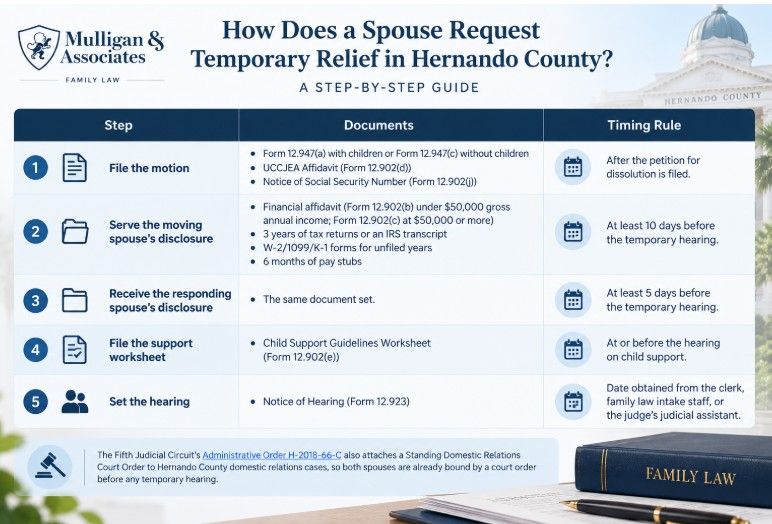
A spouse requests temporary relief in three steps:
- File a temporary support motion in the pending Hernando County dissolution case.
- Serve the required financial documents.
- Set a hearing through the assigned judge’s office.
The Fifth Judicial Circuit’s Administrative Order H-2018-66-C also attaches a Standing Domestic Relations Court Order to Hernando County domestic relations cases, so both spouses are already bound by a court order before any temporary hearing.
| Step | Documents | Timing Rule |
| File the motion | Form 12.947(a) with children or Form 12.947(c) without children, plus the UCCJEA Affidavit (Form 12.902(d)) and Notice of Social Security Number (Form 12.902(j)) | After the petition for dissolution is filed |
| Serve the moving spouse’s disclosure | Financial affidavit (Form 12.902(b) under $50,000 gross annual income; Form 12.902(c) at $50,000 or more), 3 years of tax returns or an IRS transcript, W-2/1099/K-1 forms for unfiled years, 6 months of pay stubs | At least 10 days before the temporary hearing |
| Receive the responding spouse’s disclosure | The same document set | At least 5 days before the temporary hearing |
| File the support worksheet | Child Support Guidelines Worksheet (Form 12.902(e)) | At or before the hearing on child support |
| Set the hearing | Notice of Hearing (Form 12.923) | Date obtained from the clerk, family law intake staff, or the judge’s judicial assistant |
Documents already served in the 45-day mandatory disclosure exchange do not need to be served again. Under Rule 12.285(g), a document not served within these deadlines is inadmissible at the temporary hearing unless the court finds good cause.
The Fifth Judicial Circuit’s Hernando County Mediation Services program handles divorce mediation for parties whose combined yearly income is less than $100,000. Parties above that income level must use a private mediator.
What Should a Spouse Prepare Before a Temporary Relief Hearing?
A spouse preparing for a temporary relief hearing should assemble the Rule 12.285 disclosure package early, document the children’s current routine, and keep paying ordinary household bills.
A temporary hearing typically runs on financial affidavits, disclosure documents, and limited testimony, while the final hearing follows discovery and mediation. The documents filed early therefore shape the order that governs the months ahead.
Mulligan & Associates advises spouses in contested Hernando County cases to take four steps:
- Keep copies of every bank, credit card, and retirement statement, and track all spending.
- Continue paying regular household bills while the case is pending.
- Log daily time with the children, school events attended, and shared activities.
- Avoid emptying accounts, canceling insurance, changing beneficiaries, or selling property without legal guidance.
Clients work with Christopher Mulligan directly from the first call through every hearing. The firm also handles emergency motions when a child’s safety requires immediate court action.
Frequently Asked Questions
How long does temporary alimony last in Florida?
Temporary alimony in Florida lasts from the date of the court’s order until the final judgment of dissolution, unless the court modifies or ends it sooner. The length therefore depends on how long discovery, mediation, and any trial take in the specific Hernando County case.
Does a spouse have to file for divorce before requesting temporary support in Florida?
Yes. Florida’s temporary support motion, Form 12.947(a), can be used only after a petition for dissolution of marriage is filed. A spouse seeking support without divorcing can file a petition for support unconnected with dissolution under Florida Statutes Section 61.09 instead.
How is temporary child support calculated in Hernando County?
Temporary child support in Hernando County follows the Florida child support guidelines in Section 61.30. The court combines both parents’ net incomes, applies the statutory schedule, and adjusts for health insurance, child care costs, and each parent’s share of overnights under the temporary parenting plan.
Can a judge order a spouse to move out of the house during a Florida divorce?
Yes, a Florida judge may award one spouse temporary exclusive use and possession of the marital home while the divorce is pending. The order controls who lives in the residence but does not transfer ownership, which the court decides through equitable distribution at final judgment.
Does a temporary order decide the final outcome of a Florida divorce?
No, a Florida temporary order governs only the period before final judgment and does not bind the judge’s final rulings on alimony, time-sharing, or property. The final judgment rests on the full evidentiary record, including discovery and testimony that a temporary hearing rarely reaches.
What happens if a spouse stops paying court-ordered temporary support in Florida?
The receiving spouse may file a motion for contempt or enforcement, and Florida Statutes Section 61.12 authorizes garnishment of unpaid alimony or child support. Section 61.16 also bars enforcement-case fee awards to a spouse who refused, without justification, to follow the order.
Can a temporary support order be changed before the divorce is final?
Yes, either spouse can file a motion asking the court to modify a temporary order when income, expenses, or the parenting schedule changes before final judgment. The requesting spouse serves updated financial disclosure, and the judge decides whether the change justifies new temporary terms.
What documents are needed for a temporary relief hearing in Florida?
Florida Family Law Rule 12.285 requires a financial affidavit, 3 years of tax returns or an IRS transcript, W-2 or 1099 forms for any unfiled year, and 6 months of pay stubs. A parent seeking child support also files the guidelines worksheet, Form 12.902(e).
Bottom Line
- Florida law lets either spouse request temporary alimony, child support, time-sharing, exclusive use of the home, debt payment, and attorney’s fees while a divorce is pending.
- The spouse seeking relief serves Rule 12.285 disclosure at least 10 days before the hearing, and the responding spouse serves at least 5 days before.
- Temporary orders last until final judgment unless the court modifies or ends them sooner, and they do not decide the final outcome.
Temporary orders shape daily life for months before a final judgment. Mulligan & Associates helps spouses request fair temporary terms from the first filing.

About the Author
Christopher S. Mulligan
Florida Bar Member in Good Standing since November 9, 2007 (Bar No. 47524) · J.D., The George Washington University Law School, 2006
Christopher S. Mulligan is a third-generation Florida attorney and founder of Mulligan & Associates in Brooksville, Florida. He drafted provisions of the 2005 Violence Against Women Act reauthorization and serves as a Guardian ad Litem and Attorney ad Litem for children in foster care. He has practiced family law in Hernando County since 2007 and represents families in divorce, custody, support, adoption, dependency, and injunction matters throughout the Fifth Judicial Circuit.