
How to Enforce a Divorce Settlement in Hernando County When Your Ex Won’t Comply
Enforcing a divorce settlement means asking a Hernando County judge to compel a former spouse to follow the final judgment of dissolution or a marital settlement agreement the court adopted. The remedy available depends on what the ex-spouse is ignoring.
A Florida court can jail a noncompliant spouse for skipping support or a parenting plan, but Florida courts cannot use contempt to force payment of a property settlement.
A former spouse pursuing an unpaid equalization payment instead collects it like any creditor collects a debt.
Key Takeaways
- Florida Statutes Section 61.14 lets either party petition the circuit court to enforce a support obligation.
- Contempt cannot compel payment of an equitable distribution award; Vinson v. Vinson, 296 So. 3d 960 (Fla. 1st DCA 2020), confirms property division is collected like any other debt.
- Bowen v. Bowen, 471 So. 2d 1274 (Fla. 1985), requires a finding that the noncompliant spouse has the present ability to pay before a judge can order incarceration.
- Florida Supreme Court Approved Family Law Form 12.960 opens a civil contempt or enforcement proceeding in the same case that granted the original divorce.
A former spouse who stops paying or performing does not get a second chance to relitigate the divorce. Mulligan & Associates files enforcement motions that put deadlines back on the table.
What Can Be Enforced After a Florida Divorce?
A Florida final judgment of dissolution, and any settlement agreement it incorporates, can be enforced through the same court that granted the divorce.
Common enforcement targets include unpaid alimony or child support, a parenting plan a spouse ignores, an unpaid equalizing payment, an unexecuted deed or account transfer, and unpaid attorney’s fees the judgment ordered.
Section 61.14 authorizes either party to petition the circuit court to enforce a support order when circumstances warrant it.
The remedy a court can order depends on which obligation the ex-spouse broke, because Florida separates money-support obligations from property obligations.
| Obligation Ignored | Available Remedy | Legal Source |
| Alimony or child support | Civil contempt, income deduction, garnishment | Fla. Stat. §§ 61.14, 61.1301 |
| Parenting plan or time-sharing | Civil contempt, make-up time-sharing, plan modification | Fla. Stat. § 61.13(4) |
| Equitable distribution (property, equalizing payment) | Judgment lien, writ of execution, garnishment as an ordinary civil debt | Vinson v. Vinson, 296 So. 3d 960 (Fla. 1st DCA 2020) |
| Attorney’s fees the judgment already ordered | Enforceable the same way as the underlying obligation it accompanies (support-related fees via contempt; property-related fees via civil collection) | Fla. Stat. § 61.16 |
Why Contempt Works for Support and Parenting Time But Not Property
Florida courts treat unpaid support as an ongoing duty a spouse owes a dependent family member, while a property settlement is treated as an ordinary debt between two adults. That distinction decides whether jail time is on the table.
Support and Parenting Plan Violations
A judge can hold a former spouse in civil contempt for failing to pay alimony or child support, or for repeatedly violating a parenting plan.
Section 61.13(4) lets a court order make-up time-sharing, order a parent to pay costs caused by the violation, or modify the parenting plan when a parent refuses to follow it.
Under Bowen v. Bowen, 471 So. 2d 1274 (Fla. 1985), the Florida Supreme Court held that a judge who orders incarceration to force compliance must make a separate finding that the noncompliant spouse has the present ability to pay the purge amount that will end the jail time.
The purge amount, not the underlying arrearage, is what the noncompliant spouse must be able to pay to walk free.
Property Division Violations
Contempt cannot force payment of an equitable distribution award. In Vinson v. Vinson, the First District Court of Appeal held that a lump-sum equalizing payment from property division is not enforceable by contempt, because Florida’s constitution bars jailing someone for failing to pay a debt.
A former spouse owed an equalizing payment instead uses the tools any creditor uses: a judgment lien, a writ of garnishment, or a writ of execution directing the sheriff to seize non-exempt property.
Some judgments blend both categories, such as a parenting plan paired with a property division. In that situation, contempt can address the parenting violation while collection remedies handle the unpaid property payment, even inside the same enforcement case.
Mulligan & Associates routinely sees clients confuse these two tracks, filing a contempt motion when the actual obligation is a property debt that needs a lien or garnishment instead.
How Does a Spouse File a Motion for Civil Contempt or Enforcement?
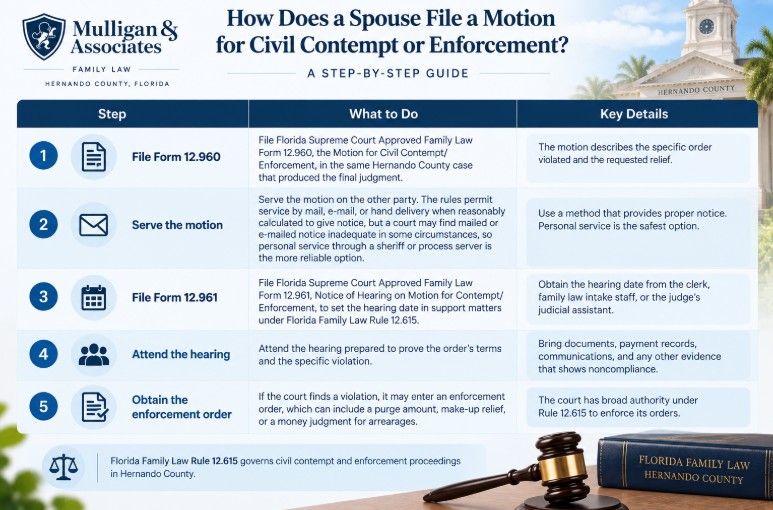
A spouse enforces a support or parenting obligation by filing Florida Supreme Court Approved Family Law Form 12.960, the Motion for Civil Contempt/Enforcement, in the same Hernando County case that produced the final judgment.
The motion explains what the other party was ordered to do and how that party failed to comply. Florida Family Law Rule 12.615 governs the proceeding.
- File Form 12.960 describing the specific order violated and the requested relief.
- Serve the motion. The rules permit service by mail, e-mail, or hand delivery when reasonably calculated to give notice, but a court may find mailed or e-mailed notice inadequate in some circumstances, so personal service through a sheriff or process server is the more reliable option.
- File Form 12.961, Notice of Hearing on Motion for Contempt/Enforcement, to set the hearing date in support matters under Rule 12.615.
- Attend the hearing prepared to prove the order’s terms and the specific violation.
- Obtain the enforcement order, which may include a purge amount, make-up relief, or a money judgment for arrearages.
For support cases, Section 61.1301 requires the court to enter a separate income deduction order alongside most orders that establish, enforce, or modify alimony or child support.
The deduction order takes effect immediately unless the court finds good cause to delay it, which routes future payments directly from the paying spouse’s paycheck.
What Happens at a Hernando County Enforcement Hearing?
At the hearing, the spouse seeking enforcement must prove the court order’s exact terms and the other spouse’s specific failure to comply.
Florida Statutes Section 61.14(5)(a) creates a statutory presumption that the original support order gives the obligor the present ability to pay, which shifts the burden to the noncompliant spouse to show why that presumption no longer holds.
If the judge is considering incarceration, Bowen v. Bowen requires an additional, separate finding on the specific purge amount before that step can happen.
Hernando County hearings on these motions happen at the Hernando County Courthouse in Brooksville, before the family division judge assigned to the case.
The court can also award the prevailing spouse attorney’s fees and costs for bringing the enforcement motion, under the financial-resources standard. Section 61.16 generally applies to fee awards.
Enforcement is distinct from modification. Enforcement asks the court to apply the existing judgment; modification asks the court to change it going forward, typically under the substantial-change standard in Section 61.14.
A spouse whose ex has simply stopped paying files for enforcement, not modification. A spouse whose own circumstances have changed may need a separate modification petition alongside, or instead of, an enforcement motion.
Frequently Asked Questions
Can my ex go to jail for not paying child support in Florida?
Yes, a Florida judge can hold a parent in civil contempt for unpaid child support and order incarceration. Under Bowen v. Bowen, the judge must first find the parent has the present ability to pay the specific purge amount that ends the jail time before ordering incarceration.
Can I use contempt to collect an unpaid property settlement in Florida?
No, contempt cannot force payment of an equitable distribution award in Florida. Vinson v. Vinson confirms property division payments are collected through a judgment lien, garnishment, or writ of execution, the same tools any creditor uses against a debtor.
What form do I file to enforce a divorce judgment in Hernando County?
A spouse files Florida Supreme Court Approved Family Law Form 12.960, Motion for Civil Contempt/Enforcement, in the same case that produced the final judgment. Florida Family Law Rule 12.615 governs enforcement proceedings involving support obligations.
What happens if my ex won’t follow the parenting plan?
Under Florida Statutes Section 61.13(4), a court can hold the noncompliant parent in contempt, order make-up time-sharing, require the parent to cover costs caused by the violation, or modify the parenting plan. Repeated violations strengthen the case for a modification alongside enforcement.
How is an income deduction order used to enforce child support?
Florida Statutes Section 61.1301 requires the court to enter a separate income deduction order with most orders that establish, enforce, or modify support. The order takes effect immediately unless the court finds good cause to delay it, routing future payments directly from the obligor’s paycheck.
Does my ex have to be served in person for an enforcement motion?
Florida rules permit service by mail, e-mail, or hand delivery in addition to personal service, but a court may find mailed or e-mailed notice inadequate in some circumstances. Personal service through a sheriff or process server removes that uncertainty.
Can I recover my attorney’s fees for filing an enforcement motion?
Yes, Florida Statutes Section 61.16 lets the court order the noncompliant spouse to pay the other spouse’s attorney’s fees and costs after considering both spouses’ financial resources. The court may deny fees to a noncompliant party found to have refused compliance without justification.
What if my ex claims they can’t afford to pay?
Section 61.14(5)(a) presumes the noncompliant spouse can pay based on the original order, so that spouse bears the burden of showing changed circumstances. That is the same present ability to pay standard. Bowen v. Bowen requires the court to weigh before ordering incarceration.
Bottom Line
- Florida separates support and parenting enforcement, which contempt can reach, from property division enforcement, which cannot.
- Form 12.960 opens the enforcement proceeding, and Bowen v. Bowen governs whether jail time is available for support violations.
- An unpaid equalizing payment is collected through a lien, garnishment, or writ of execution, not contempt.
A former spouse who stops complying cannot rewrite the judgment by ignoring it. Mulligan & Associates moves quickly to restore compliance with the terms already ordered.

About the Author
Christopher S. Mulligan
Florida Bar Member in Good Standing since November 9, 2007 (Bar No. 47524) · J.D., The George Washington University Law School, 2006
Christopher S. Mulligan is a third-generation Florida attorney and founder of Mulligan & Associates in Brooksville, Florida. He drafted provisions of the 2005 Violence Against Women Act reauthorization and serves as a Guardian ad Litem and Attorney ad Litem for children in foster care. He has practiced family law in Hernando County since 2007 and represents families in divorce, custody, support, adoption, dependency, and injunction matters throughout the Fifth Judicial Circuit.