
Emergency Child Custody in Hernando County: When Can a Parent Ask the Court for Immediate Relief? (2026 Guide)

An emergency custody motion is a sworn request asking a Florida court to change where a child stays, or to block a child’s removal, before a normal hearing can be scheduled.
In Hernando County, the Fifth Judicial Circuit’s Verified Motion for Emergency Relief limits a “true emergency” to two situations: a child threatened with physical harm, or a child about to be improperly removed from Florida.
Mulligan & Associates, a Brooksville child custody firm, files these motions when a child’s safety cannot wait, and separate Florida procedures cover other urgent situations.
Key Takeaways
- The Fifth Judicial Circuit’s Verified Motion for Emergency Relief requires a sworn certification that a child faces a threat of physical harm or improper removal from Florida.
- The Hernando County form instructions limit that motion to a person with a pre-existing legal right to physical possession of the child and define which unmarried parents qualify.
- Courts rarely grant emergency motions without a hearing and prior notice, and Rule 1.610 limits injunctions without notice to cases of immediate and irreparable harm.
- The instructions warn that abuse of the emergency motion may bring sanctions, including contempt, and the motion is signed under penalties of perjury.
A child’s safety cannot wait for the next open hearing date. Mulligan & Associates prepares emergency custody motions that meet the Fifth Judicial Circuit’s sworn standard.
What Counts as an Emergency in a Hernando County Custody Case?
The Fifth Judicial Circuit’s Verified Motion for Emergency Relief treats a custody situation as a true emergency when a child is threatened with physical harm or is about to be improperly removed from Florida.
The Hernando County emergency motion and instructions require the filer to certify one of those two grounds under oath. That two-ground definition governs this local motion only.
Florida law separately provides urgent procedures for removal injunctions, pick-up orders, domestic violence, and children recently brought from another state.
| Situation | Fits the Fifth Judicial Circuit Form’s “True Emergency” Definition? | Typical Filing |
| Child threatened with imminent physical harm | Yes | Verified Motion for Emergency Relief |
| Child about to be improperly taken out of Florida | Yes | Verified Motion for Emergency Relief or Form 12.941(a) removal injunction |
| Child withheld in violation of an existing order | Depends on the facts | Form 12.941(d) Emergency Verified Motion for Child Pick-Up Order |
| Domestic violence against the child’s parent | Handled through a separate statute | Petition for injunction under Section 741.30 |
| Suspected abuse, abandonment, or neglect | Reporting required under the form instructions | DCF report at 1-800-962-2873 |
| Disagreements over schedules, school, or routines | No | Regular motion or supplemental petition to modify |
Parenting disagreements outside both emergency grounds can still reach the court on the normal schedule through a custody modification or an enforcement motion.
Who Can File an Emergency Custody Motion in Hernando County?
Eligibility for the Fifth Judicial Circuit’s emergency motion depends on whether the filer already holds a legal right to have the child in their physical care. A parent without that existing right cannot use the local form, and the statewide Form 12.941(d) pick-up motion applies the same threshold.
Under the Hernando County instructions, a filer meets that threshold in one of four ways:
- A prior court order already grants the filer custody or time-sharing.
- The filer is legally married to the child’s other parent.
- The filer is the unmarried mother, and the child’s birth certificate names no father.
- The filer is an unmarried father named on the birth certificate, and more than 60 days have elapsed since he signed a paternity acknowledgment, a timeline the instructions link to Section 742.10(1).
The four categories answer only one narrow question: who qualifies to file this local motion.
A parent’s wider rights under Florida paternity and parental-responsibility law raise a different issue, particularly where paternity has never been legally established.
A parent who fits none of the categories typically needs to establish paternity or start a case in Hernando County family court before this motion becomes available.
Can a Judge Grant Emergency Custody Without Notifying the Other Parent?
A judge can enter an emergency order without advance notice, but the Fifth Judicial Circuit instructions state that emergency motions are rarely granted without a hearing and prior, reasonable notice to the other parent.
The motion must either describe the efforts made to notify the other parent or state specific facts showing that notice would cause immediate or irreparable harm to the child.
The instructions for the removal and passport injunction, Form 12.941(a), point to Florida Rule of Civil Procedure 1.610. That rule allows a temporary injunction without notice only when sworn facts show immediate and irreparable injury before the other party can be heard, and the movant’s attorney certifies the notice efforts made.
Rule 1.610 also waives the bond for an injunction issued solely to prevent physical injury or abuse, and it lets the restrained party move to dissolve the injunction at any time.
When the court acts without notice, the Fifth Judicial Circuit instructions direct the filer to take a certified copy of the order to the sheriff’s office, and the motion and order must be personally served on the other parent.
The order may direct the sheriff to place the child somewhere other than with the filing parent, so the placement terms and hearing date deserve close reading.
How Does a Parent File an Emergency Motion in Hernando County?
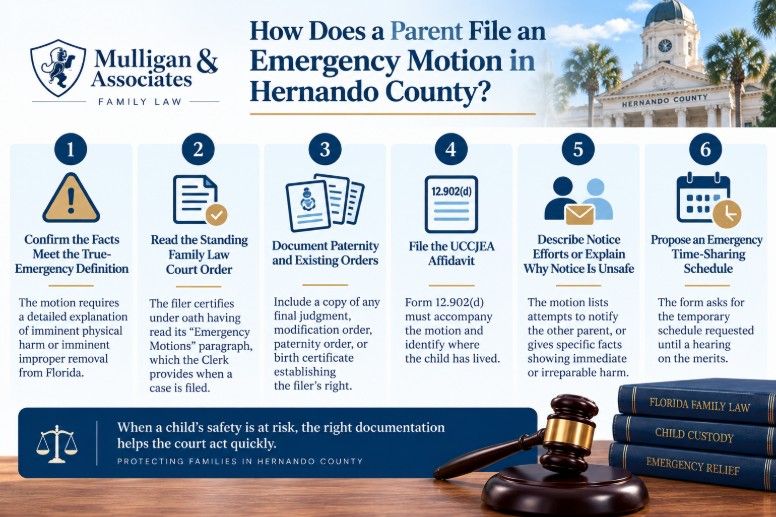
A parent files an emergency custody motion in Hernando County by completing the Fifth Judicial Circuit’s Verified Motion for Emergency Relief, attaching the required documents, and filing a UCCJEA affidavit with it.
Each step affects whether the judge treats the filing as a genuine emergency under Florida custody laws.
- Confirm the facts meet the form’s true-emergency definition. The motion requires a detailed explanation of imminent physical harm or imminent improper removal from Florida.
- Read the Standing Family Law Court Order. The filer certifies under oath that they have read its “Emergency Motions” paragraph, which the Clerk provides when a case is filed.
- Document paternity and existing orders. The motion requires a copy of any final judgment, modification order, paternity order, or birth certificate establishing the filer’s right.
- File the UCCJEA affidavit. Form 12.902(d) must accompany the motion and identify where the child has lived.
- Describe notice efforts or explain why notice is unsafe. The motion lists attempts to notify the other parent, or gives specific facts showing immediate or irreparable harm.
- Propose an emergency time-sharing schedule. The form asks for the temporary schedule requested until a hearing on the merits.
The emergency form asks for existing orders, the child’s location, and dated facts. Mulligan & Associates reviews those documents with parents before filing.
What Happens After an Emergency Order Is Entered?
An emergency order provides temporary relief until the court holds a hearing on the merits or enters a further order. At that hearing, the filer presents evidence supporting the sworn motion, and the other parent has an opportunity to respond.
The Follow-Up Hearing
The Fifth Judicial Circuit instructions direct the filer to note the hearing time and place in the order and to bring supporting evidence.
When the court declines to act without notice, the filer schedules a hearing through the Clerk, the judicial assistant, or the Family Court Case Manager, unless the denial order sets one.
The outcome can shape later child custody decisions in Hernando County, so the evidence presented deserves the same care as the motion itself.
Children Recently Brought From Another State
Section 61.517 gives a Florida court temporary emergency jurisdiction when the child is present in Florida and has been abandoned.
It also applies when protection is needed because the child, a sibling, or a parent is subjected to or threatened with mistreatment or abuse.
A Florida court exercising that jurisdiction must communicate with a court in another state that has jurisdiction over the child.
Consequences of Misusing the Process
The Hernando County instructions warn that abuse of the emergency motion may result in sanctions, including contempt. The motion is signed under penalties of perjury under Section 92.525, Florida Statutes, so every fact must be accurate when the parent files it.
When Is an Injunction or DCF Report the Better Path?
A domestic violence injunction or a report to the Florida Department of Children and Families can be the better path when the danger involves violence against a parent or abuse of the child. Each process runs on its own statute and can operate alongside a custody case.
Section 741.30 lets a court grant a temporary injunction ex parte when an immediate and present danger of domestic violence exists, and the injunction can include a temporary parenting plan with a time-sharing schedule.
A petition for a Brooksville injunction proceeds separately from the custody case, even when both involve the same child.
The Hernando County instructions state that abuse, abandonment, or neglect of a child must be reported to DCF at 1-800-962-2873. A DCF investigation can lead to a dependency case under Chapter 39, which follows its own process separate from Chapter 61 custody litigation.
Mulligan’s work as a court-appointed advocate for children in dependency proceedings informs how the firm approaches these overlapping tracks.
The firm’s published Brooksville case study describes a DCF removal reversed with four children returned to their mother within days, a result that turned on that case’s specific facts.
Frequently Asked Questions
What counts as an emergency for a custody motion in Hernando County?
The Fifth Judicial Circuit’s Verified Motion for Emergency Relief defines two true emergencies: a child threatened with physical harm, or a child about to be improperly removed from Florida. Other urgent situations may fit separate procedures, such as injunctions or pick-up orders.
Can an unmarried father file an emergency custody motion in Florida?
Possibly. The Hernando County form instructions accept an unmarried father named on the birth certificate once more than 60 days have passed since he signed an acknowledgment of paternity, citing Section 742.10(1). A court order awarding custody or time-sharing also qualifies.
Will the other parent be notified of an emergency custody motion?
Usually, yes. The Fifth Judicial Circuit instructions state that emergency motions are rarely granted without a hearing and prior, reasonable notice. A judge may act without notice only when sworn facts show immediate or irreparable harm would occur before the other parent could be heard.
What is a child pick-up order in Florida?
A child pick-up order directs the sheriff or another law enforcement officer to take a child from the person holding the child and deliver the child to the filer. Florida Supreme Court Approved Family Law Form 12.941(d) requests the order in an emergency.
How can a parent stop the other parent from taking a child out of Florida?
A parent can file Florida Supreme Court Approved Family Law Form 12.941(a), a Verified Motion for Temporary Injunction to Prevent Removal of Minor Child(ren) and/or Denial of Passport Services. The court may enter the injunction ex parte or after notice, depending on the facts shown.
What happens if a parent files a false emergency custody motion?
The Hernando County instructions warn that abusing the emergency motion may result in sanctions, including contempt. The motion is signed under penalties of perjury under Section 92.525, Florida Statutes, so knowingly false statements can create separate legal consequences for the filer.
Can a Florida court issue emergency custody orders for a child who just arrived from another state?
Yes, under Section 61.517, a Florida court has temporary emergency jurisdiction when the child is present in Florida and has been abandoned or needs protection from mistreatment or abuse. The order generally remains temporary while a court with regular jurisdiction addresses custody.
Does suspected child abuse need to be reported to DCF in a custody emergency?
Yes. The Hernando County instructions state that abuse, abandonment, or neglect of a child must be reported to the Florida Department of Children and Families at 1-800-962-2873. A DCF report and an emergency custody motion can proceed at the same time.
Bottom Line
- The Fifth Judicial Circuit’s Verified Motion for Emergency Relief covers two true emergencies: threatened physical harm and imminent improper removal from Florida.
- The local form instructions limit that motion to a person with a pre-existing legal right to the child, and separate Florida procedures cover other urgent situations.
- Domestic violence injunctions and DCF reports run on separate statutes and can operate alongside a custody case.
An emergency order is only the first step toward a stable parenting plan. Mulligan & Associates carries emergency cases through the follow-up hearing.

About the Author
Christopher S. Mulligan
Florida Bar Member in Good Standing since November 9, 2007 (Bar No. 47524) · J.D., The George Washington University Law School, 2006
Christopher S. Mulligan is a third-generation Florida attorney and founder of Mulligan & Associates in Brooksville, Florida. He drafted provisions of the 2005 Violence Against Women Act reauthorization and serves as a Guardian ad Litem and Attorney ad Litem for children in foster care. He has practiced family law in Hernando County since 2007 and represents families in divorce, custody, support, adoption, dependency, and injunction matters throughout the Fifth Judicial Circuit.