
Divorce Attorney in Brooksville, FL | Mulligan & Associates
Divorce can feel like you’re losing your footing. One day, you’re trying to keep life normal for the kids. The next time you’re staring at bank statements, deadlines, and decisions that will shape your future for years.
You do not need vague reassurance. You need a clear plan, clean paperwork, and a lawyer who can protect your time-sharing and your finances without inflaming the situation.
Mulligan & Associates helps Brooksville families move from uncertainty to structure. We clarify what matters first, what can wait, and what mistakes cost the most.
Then we guide you through a settlement-forward strategy when it is safe, and a litigation-ready strategy when it is not.
Divorce Lawyer in Brooksville for Clear Next Steps
Divorce in Florida is a no-fault process. You can file if at least one spouse has lived in Florida for 6 months. (leg.state.fl.us)
We help Brooksville clients protect parenting time, financial stability, and a clean path to final judgment, whether your case resolves through agreement or requires court involvement.
Who We Help in Brooksville
Divorce is not one problem. It is parenting, money, and emotional pressure happening at the same time.
We help people who need a steady, practical approach that turns chaos into next steps.
- You want an uncontested divorce, but you still need the paperwork and terms done correctly
- Your spouse is stalling, threatening, or refusing to cooperate
- You have children and need a workable time-sharing schedule and parenting plan
- You are worried about the home, debt, retirement accounts, or uneven access to money
- You need temporary relief to stabilize parenting time, communication, or finances
What We Do. Divorce Representation That Protects Kids and Money
A Florida divorce forces decisions you cannot avoid. Parenting plan and time-sharing, support, property, and debt.
We help you get organized early, understand your leverage, and push toward a durable outcome that holds up after the case ends.
If your divorce involves parenting time, start with our child custody representation. If child support is part of the issue, see our child support guidance.
Uncontested vs Contested Divorce. What Changes, What Drives Delay
An uncontested divorce means you and your spouse agree on every major term. Parenting, support, and finances.
A contested divorce means at least one issue is disputed, which usually triggers more deadlines, more disclosure, mediation, and sometimes hearings.
The biggest delays tend to come from service issues, missing financial documents, and unresolved parenting or money disputes.
| Decision area | Uncontested divorce | Contested divorce | What usually causes delays |
| Parenting plan and time-sharing | Both parents agree on the schedule and decision-making | Disagreement on schedule, holidays, exchanges, or decision-making | Vague proposals, high conflict, missed documentation, repeated revisions |
| Child support | Income and support terms are agreed | Dispute about income, overnights, expenses, or imputed income | Missing pay stubs, tax returns, employer changes, and side income disputes |
| Alimony | Either agreed or not requested | Disagreement on need, ability to pay, or duration | Incomplete financial disclosure, lifestyle disputes, contested budgets |
| Property and debt | You agree on who keeps what and who pays what | Dispute about valuation, fairness, or hidden assets | Unclear account history, appraisals, tracing issues, and delayed statements |
| Court involvement | Minimal. paperwork and a short final step | More court events. motions, mediation, hearings, trial possible | Court scheduling, continuances, and noncompliance with deadlines |
| Timeline control | High. You control the pace | Lower. pace often depends on conflict and the court calendar | Service problems, disclosure gaps, unresolved parenting or finances |
If you need a reality check on whether your case can stay uncontested, review uncontested divorce in Hernando County. If you were just served or expect pushback, start with what happens in a contested Florida divorce.
How Divorce Works in Florida. The 6 Step Roadmap
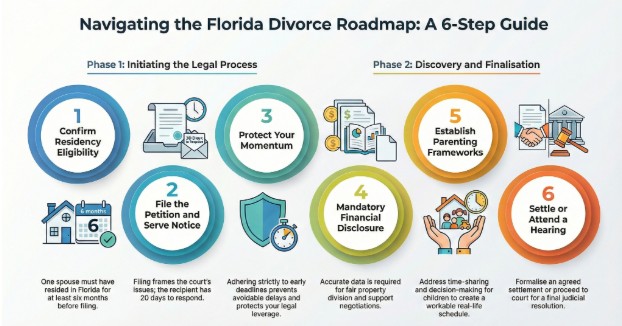
Florida divorce follows a predictable sequence. Confirm residency, file the petition, complete service, exchange mandatory financial disclosure, address parenting and support when children are involved, then finalize by settlement or hearing.
Getting the early steps right reduces rework, prevents avoidable delays, and protects your leverage when negotiating parenting time and financial terms.
- Confirm residency eligibility
At least one spouse must have lived in Florida for 6 months before filing. - File the petition with the clerk
This starts the case and frames the issues the court must decide. - Serve the other spouse and calendar deadlines
Pay close attention to the 20-day response deadline after service so you do not lose time or momentum early. - Exchange financial disclosure
Property division, support, and settlement leverage depend on accurate numbers, not guesses. - Build the parenting and support framework if children are involved
This is where time-sharing schedules, decision-making, and support terms become workable in real life. If parenting time is the core issue, it can help to review child custody representation alongside the divorce plan. If support is the pressure point, see child support guidance. - Settle or proceed to the final hearing
If you agree on terms, you formalize them. If you do not, the case moves through the court process toward a final resolution.
What You Need to Decide Early
Most divorce outcomes hinge on a short list of early decisions. What the parenting schedule will look like in real life, how bills will be paid while the case is pending, what happens to the home, how debts will be handled, and what information must be disclosed.
Clear early decisions reduce temporary hearings, prevent expensive back-and-forth, and help you negotiate from a calmer, stronger position.
- Parenting schedule and exchanges
- School and healthcare decision-making
- Temporary financial plan during the case
- Home, vehicles, and household bills
- Asset and debt inventory
- Support expectations and documentation
- Communication rules and boundaries
If safety is part of the conflict, a separate plan may be needed. In those situations, an injunction and a restraining order can help stabilize boundaries while the divorce is pending.
Consultation Checklist. What to Bring, What to Prepare
The fastest way to reduce delays is to show up with clean documents and a clear snapshot of your household finances. Bring what you can now.
We can fill gaps later, but starting with accurate income, debts, and account statements helps you negotiate from a position of strength.
For a deeper list, see the financial documents for a Florida divorce.
- Dates. marriage, separation, move-outs
- Names and ages of children, plus school and childcare details
- Last 3 years tax returns
- Last 2 to 3 months’ pay stubs and proof of income
- Bank statements
- Retirement and investment statements
- Mortgage or rent statements, plus vehicle loans
- Credit card statements and other debts
- Monthly expenses list (childcare, insurance, utilities, subscriptions)
- Deeds, titles, and insurance declarations
- Any prior court orders or written agreements
- Any safety concerns and related paperwork
- Your top 3 outcomes and top 3 dealbreakers
Proof You Can Trust. What Clients Say and What That Means for Your Case
In divorce, “good service” is not a vibe. It is what happens when you are stressed, the stakes are high, and deadlines do not wait.
These reviews highlight what clients consistently value. being heard, being protected in court, and having a lawyer who stays prepared and steady when it matters most.
- “Mr. Mulligan was the lawyer I retained in a civil matter that most other lawyers didn’t want to take on… Mr. Mulligan represented me well throughout all of the proceedings and shone exceptionally during the final hearing… he was my voice… I am extremely grateful for Mr. Mulligan and his entire team for their hard work and dedication on my case.” . Ellen McCarthy-Trufant
- “Very dedicated and works hard for his clients. Chris is extremely knowledgeable about family law. I would definitely recommend him to anyone who needs representation in these matters. He cares about his clients and represents them well when it matters most.” Ashley Testerman
- “Mr. Mulligan has been my attorney for quite some time now, and he has yet to let me down… He is not afraid to speak up in court… He may sometimes be blunt, but I appreciate his no-nonsense approach.” Sydni O’Reilly
- “Mr. Mulligan and staff are the most professional, caring individuals… prompt communications, and letting us know what to expect. I would hire Mr. Mulligan time and time again.” . Sydni O’Reilly
Frequently Asked Questions
What is the Florida residency requirement to file for divorce?
Florida’s residency requirement means that at least one spouse must have lived in Florida for at least six months before filing for divorce. Only one spouse needs to qualify. If residency is questioned, you may need basic proof, such as identification, records, or testimony. Confirm this before filing to avoid a preventable delay.
How long does divorce take in Florida for uncontested and contested cases?
A Florida divorce moves faster when both spouses agree on all terms and the paperwork is complete. Contested cases take longer because they involve financial disclosure, negotiation, mediation, and sometimes hearings. Delays usually stem from service issues, missing documents, or unresolved parenting or financial issues. Organizing early often shortens the timeline.
Can my spouse stop the divorce by refusing to cooperate?
In Florida, a spouse cannot permanently stop a divorce by refusing to cooperate. They can slow it down by avoiding service, withholding documents, or forcing court hearings. In Brooksville cases, that often looks like stalling rather than a true legal barrier.
What happens after I am served with divorce papers in Florida?
Being served starts the response window and puts your divorce on a court timeline. Your next step is to review what was filed and the calendar deadlines, and to begin gathering financial and parenting information.
What documents matter most for financial disclosure and settlement?
Financial disclosure documents show income, assets, debts, and expenses, so settlement terms are based on real numbers. The most important items are tax returns, pay stubs, bank statements, retirement account statements, and loan and credit card statements.
Do we have to go to court if we agree on everything?
Even if you agree on everything, divorce still requires filing and a final court step to make your agreement enforceable. In many uncontested cases, court involvement is brief and procedural. The usual problem is not the court.
If we have children, what should be decided first?
If you have children, the first priority is a workable parenting plan that covers time-sharing, decision-making, school, healthcare, holidays, and exchanges. The goal is a schedule that fits real life, not a plan that collapses in two weeks. In Brooksville divorces, early clarity on parenting reduces conflict and protects stability.
Choose the Next Step That Matches Your Situation
When divorce already has you stretched thin, the wrong next click wastes time and keeps you stuck in the same questions.
Use these links to get clarity fast. Pick the one that matches the pressure you feel most right now.
- If you’re worried about losing time with your child, start with custody and time-sharing options.
If support is the conflict point, and you need clear numbers and enforceable terms, start here. - If threats, harassment, or escalation are changing how you live day to day, review protection options.
- If a dependency or child protection case is involved, and you feel like the system is moving faster than you can keep up, start here.
- If your family is growing through adoption and you want the process handled the first time, correctly, start here.
Talk to Mulligan & Associates. Confidential Consultation and Clear Next Steps
Divorce can make everything feel high-risk. One wrong assumption. One rushed agreement.
One schedule that looks fine on paper but falls apart in real life. The goal of your first call is simple. Replace uncertainty with a plan.
We’ll focus on what matters most right now. Your children. Your finances. Your safety. Your deadlines.
Then we’ll map the next step to protect your position and reduce chaos. You’ll leave the call knowing what to do next, what to avoid, and what to gather so your case can move forward.
Tap to call: 352-593-5990