
What If Your Ex Won’t Refinance or Sell the Marital Home After Divorce in Hernando County? (2026 Guide)

Refusing to refinance or sell the marital home after divorce leaves both former spouses tied to one mortgage because a Florida divorce judgment binds the spouses but not the lender.
Mulligan & Associates, a Brooksville divorce firm, handles post-judgment enforcement when a former spouse ignores a refinance or sale deadline.
Florida courts generally treat signing documents and cooperating with a sale as acts that civil contempt can compel.
A straight money debt is collected through execution or garnishment instead, and the exact remedy depends on the judgment’s wording and the ex-spouse’s ability to comply.
Key Takeaways
- A divorce judgment allocates the mortgage between former spouses, but only a refinance, payoff, or lender release removes a borrower from the loan.
- Florida Rule of Civil Procedure 1.570(c) lets a court enforce a judgment requiring a specific act through contempt, a writ of attachment, or a court-appointed person who performs the act.
- Roth v. Roth (Fla. 2d DCA 2008) upheld contempt for refusing to sign documents a final judgment required, but the Fifth District, which hears Hernando County appeals, reversed contempt over a quitclaim deed in LaRoche v. LaRoche (1995).
- Contempt requires the ex-spouse to be able to comply, so a lender’s refinance denial raises different questions than a deliberate refusal.
A missed refinance deadline keeps both names on the loan every month it goes unresolved. Mulligan & Associates enforces home-related orders in Hernando County.
Why Doesn’t a Divorce Judgment Remove a Spouse From the Mortgage?
A Florida divorce judgment cannot remove a spouse from a mortgage because the lender was never a party to the divorce case. Both borrowers stay responsible to the lender until the loan is refinanced into one name, paid off through a sale, or released by the lender.
A missed payment on a joint loan can damage the credit of a former spouse who stays on the mortgage.
| What the Judgment Controls | What the Judgment Does Not Control |
| Who owns the home between the former spouses | The lender’s right to collect from either borrower |
| The deadline and terms for refinancing or selling | Whether a lender approves a refinance application |
| Which former spouse must pay the mortgage as between the two of them | Credit reporting on a loan still in both names |
Section 61.075 governs how a Florida court divides marital assets and liabilities, including the home. Through equitable distribution, a final judgment can award the house, set a refinance deadline, or order a sale. Those terms bind the former spouses, not the lender.
Can Contempt Force an Ex-Spouse to Refinance or Sell the Marital Home?
Florida courts can generally use civil contempt to compel an ex-spouse to sign refinance or sale documents required by a final judgment, because signing is an act rather than a payment of money.
Contempt cannot collect a money obligation arising from property division. Florida appellate courts have also not treated every home-related obligation the same way.
Signing and Sale Cooperation Are Acts
Florida Rule of Civil Procedure 1.570(c), which Family Law Rule 12.570 incorporates, lets a court hold a party in contempt for failing to perform a specific act a judgment requires. In Roth v. Roth, No. 2D06-3360 (Fla. 2d DCA Jan. 9, 2008), the Second District affirmed contempt against a former husband who refused to sign a mortgage and promissory note the final judgment required.
The Roth opinion also relied on Firestone v. Ferguson, 372 So. 2d 490 (Fla. 3d DCA 1979), where a wife who refused to sign a sales contract at a court-ordered price was held in contempt.
Money Obligations Are Not
Said v. Bell, No. 2D2024-1449 (Fla. 2d DCA Apr. 16, 2025), reversed contempt for an unpaid $165,000 equalizing payment. The court held that property-division payments are enforceable only by the remedies a creditor uses against a debtor, citing Pipitone v. Pipitone, 23 So. 3d 131 (Fla. 2d DCA 2009).
The court affirmed, without written explanation, a separate contempt finding for failing to assume the mortgage. The Said decision therefore confirms the money-debt rule more firmly than it defines the mortgage rule.
The Fifth District Split Matters in Hernando County
Hernando County appeals go to the Fifth District Court of Appeal. That court reversed contempt for a wife’s refusal to sign a quitclaim deed in LaRoche v. LaRoche, 662 So. 2d 1018 (Fla. 5th DCA 1995), pointing to specific performance as the proper remedy.
Roth certified conflict with LaRoche and noted that the Fifth District had earlier upheld contempt for an unperformed act in Riley v. Riley, 509 So. 2d 1366 (Fla. 5th DCA 1987). That split gives the Rule 1.570 alternatives below added weight in a Hernando County case.
What Must a Contempt Motion Show?
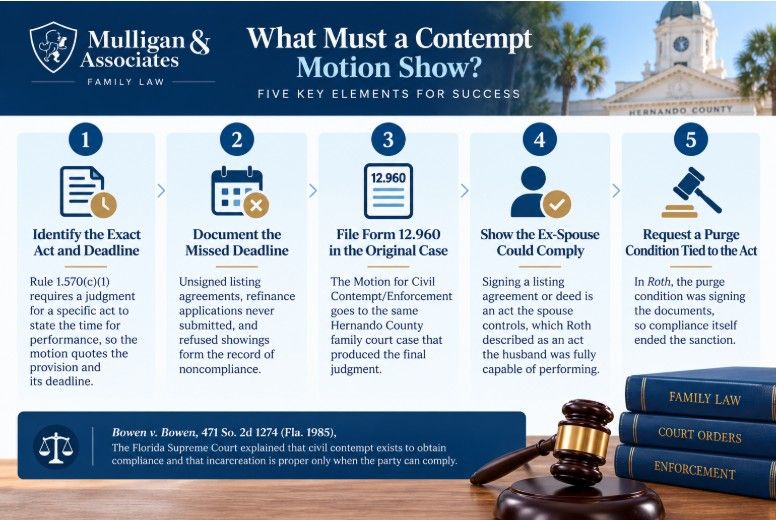
A contempt motion succeeds only when the moving spouse proves a clear obligation, a missed deadline, and that the ex-spouse could have complied but did not.
The Florida Supreme Court explained in Bowen v. Bowen, 471 So. 2d 1274 (Fla. 1985), that civil contempt exists to obtain compliance and that incarceration is proper only when the party can comply.
A contempt motion over the home typically proceeds in five steps:
- Identify the exact act and deadline. Rule 1.570(c)(1) requires a judgment for a specific act to state the time for performance, so the motion quotes the provision and its deadline.
- Document the missed deadline. Unsigned listing agreements, refinance applications never submitted, and refused showings form the record of noncompliance.
- File Form 12.960 in the original case. The Motion for Civil Contempt/Enforcement goes to the same Hernando County family court case that produced the final judgment.
- Show the ex-spouse could comply. Signing a listing agreement or deed is an act the spouse controls, which Roth described as something the husband was fully capable of doing.
- Request a purge condition tied to the act. In Roth, the purge condition was signing the documents, so compliance itself ended the sanction.
What If the Ex Cannot Qualify to Refinance?
An ex-spouse who applies in good faith and is denied by the lender has not refused to act, so contempt is a poor fit when the obstacle is the lender’s decision. The judgment’s fallback terms then control what happens next.
A settlement agreement may pair a refinance deadline with a required sale if the refinance fails.
When a judgment contains that fallback, the enforcement question shifts from the refinance to the sale. Cooperation with the listing, showings, and closing then becomes the act a court can compel.
When the judgment sets a refinance deadline with no fallback, the former spouse still on the loan may need to ask the court to address the deadlock.
The records that separate refusal from inability include:
- Refinance applications and the dates each was submitted.
- Lender approval conditions or written denial letters.
- Communications about listing price, showings, and offers.
- Mortgage statements showing who paid and when.
A lender denial and a deliberate refusal call for different motions. Mulligan & Associates matches the enforcement request to the judgment’s actual refinance terms.
What Other Remedies Exist When an Ex Won’t Sign or Cooperate?
Florida Rule of Civil Procedure 1.570 gives a court alternatives to contempt when a judgment requires a specific act, and one of them makes the ex-spouse’s signature unnecessary. Partition under Chapter 64 remains available when the judgment never disposed of the home.
| Remedy | How It Works | Legal Source |
| Writ of attachment | After an affidavit of noncompliance, the clerk issues a writ, and the party is not released until complying and paying costs | Fla. R. Civ. P. 1.570(c)(1) |
| Court-appointed person | A nonparty appointed by the court performs the act, with the same effect as if the ex-spouse performed it | Fla. R. Civ. P. 1.570(c)(3) |
| Judgment as conveyance | A judgment for a conveyance or transfer has the effect of a duly executed conveyance once recorded in the county | Fla. R. Civ. P. 1.570(d) |
| Execution or garnishment | Collects a money obligation, such as an unpaid equalizing payment | Fla. R. Civ. P. 1.570(a) |
| Partition action | Forces division or sale of property the former spouses co-own when the judgment did not dispose of it | Fla. Stat. ch. 64; § 689.15 |
The Hernando County circuit court that handled the property division can enforce its terms after judgment. When the final judgment already orders a sale, enforcement can proceed in the divorce case itself under Rule 1.570.
A home the judgment never addressed is different. Section 689.15 converts a tenancy by the entirety into a tenancy in common when the marriage is dissolved, which makes partition the same tool other co-owners use, including in property division for unmarried couples.
What Happens to the Mortgage and Credit While Enforcement Is Pending?
Both former spouses stay liable to the lender until the refinance or sale closes, even while an enforcement motion is pending.
The final judgment can decide who must pay the mortgage, taxes, insurance, and association dues as between the former spouses, but it does not change what the lender can collect or report.
Federal law limits a lender’s response to the divorce transfer itself. The Garn-St Germain Act, 12 U.S.C. § 1701j-3(d)(7), bars a lender from enforcing a due-on-sale clause on a residential loan of fewer than five dwelling units when a dissolution decree or property settlement makes the borrower’s spouse an owner.
The statute protects the loan from acceleration but does not release the departing spouse from liability.
Keeping payment records and divorce documents organized lets the former spouse on the loan show exactly when a payment was missed and who was responsible under the judgment.
Frequently Asked Questions
Does a Florida divorce judgment remove an ex-spouse from the mortgage?
No, a Florida divorce judgment allocates the mortgage between former spouses but does not bind the lender. Only a refinance into one name, a sale that pays off the loan, or a lender release removes a borrower from mortgage liability.
Can an ex-spouse be held in contempt for refusing to sign sale or refinance documents?
Generally yes. Roth v. Roth upheld contempt for refusing to sign documents a final judgment required, treating signing as an act rather than a payment. The Fifth District reached a different result on a quitclaim deed in LaRoche v. LaRoche, so outcomes can vary.
What happens if an ex-spouse applies to refinance but the lender says no?
A lender denial after a good-faith application points to inability, not refusal, and civil contempt requires the ability to comply. The judgment’s fallback terms, such as a required sale after a missed refinance deadline, typically become the next obligation a court can enforce.
Can a court sign the deed if an ex-spouse refuses?
In effect, yes. Florida Rule of Civil Procedure 1.570(c)(3) lets the court appoint a nonparty to perform the act, and Rule 1.570(d) gives a judgment for a conveyance the effect of a duly executed conveyance once recorded in the county.
Is a separate partition lawsuit needed to force a sale of the former marital home?
Often not, because a divorce court can enforce an existing sale order under Rule 1.570. Partition under Chapter 64 fits a home the judgment never disposed of, which Section 689.15 converts into a tenancy in common between the former spouses.
Is a former spouse’s credit at risk while a refinance dispute is pending?
Yes, a former spouse who remains a borrower stays liable to the lender until the refinance or sale closes. A missed payment can appear on that spouse’s credit, even when the final judgment assigns the payment to the other former spouse.
Can a lender call the loan due when the home transfers to one former spouse?
Generally, no, for homes with fewer than five units. The Garn-St Germain Act, 12 U.S.C. § 1701j-3(d)(7), bars enforcing a due-on-sale clause when a dissolution decree or property settlement makes the borrower’s spouse an owner, though it releases no one from liability.
What is the difference between enforcing a refinance order and an equalizing payment?
A refinance or sale order requires acts, such as signing documents, which Florida courts generally enforce through contempt. An equalizing payment is a money debt, and Said v. Bell held that contempt cannot collect it, leaving execution, garnishment, or other creditor remedies.
Bottom Line
- A divorce judgment governs the former spouses, not the lender, so both borrowers stay liable until a refinance, payoff, or lender release.
- Florida courts generally treat signing and sale cooperation as acts enforceable through contempt, though the Fifth District’s LaRoche decision shows outcomes can differ.
- Rule 1.570 lets a court appoint someone to perform the act or give the judgment the effect of a conveyance.
Shared mortgage liability is not a problem to wait out. Mulligan & Associates pursues compliance with the home terms the judgment already ordered.

About the Author
Christopher S. Mulligan
Florida Bar Member in Good Standing since November 9, 2007 (Bar No. 47524) · J.D., The George Washington University Law School, 2006
Christopher S. Mulligan is a third-generation Florida attorney and founder of Mulligan & Associates in Brooksville, Florida. He drafted provisions of the 2005 Violence Against Women Act reauthorization and serves as a Guardian ad Litem and Attorney ad Litem for children in foster care. He has practiced family law in Hernando County since 2007 and represents families in divorce, custody, support, adoption, dependency, and injunction matters throughout the Fifth Judicial Circuit.