
Collaborative Divorce vs. Litigation in Florida: A Side-by-Side Comparison

Data last verified: March 2026
Collaborative divorce and contested litigation represent the two ends of Florida’s dissolution spectrum — one keeps decisions with the spouses, the other hands them to a Hernando County Circuit Court judge.
Choosing between these paths before you file determines your timeline, your total cost, your privacy, and your family’s ability to co-parent after the process ends.
Christopher Mulligan at Mulligan & Associates represents Brooksville and Hernando County families through both — schedule a consultation to get a direct assessment of which path fits your situation.
Key Takeaways
- Collaborative divorce resolves the dissolution entirely outside court through structured four-way meetings governed by Florida Statutes §§ 61.55–61.58, while contested litigation places all final decisions in the hands of a Fifth Judicial Circuit judge.
- The Florida Academy of Collaborative Professionals reports that 85.1% of Florida collaborative cases reach full agreement, and 60% complete within six months — compared to one to three years for complex contested cases.
- Collaborative divorce proceedings are confidential under Florida Statutes § 61.60; contested divorce filings are public records accessible through the Hernando County Clerk of Circuit Court portal.
- Collaborative divorce is not appropriate when domestic violence, hidden assets, or a spouse’s bad-faith participation make voluntary negotiation structurally unworkable — in those situations, contested litigation provides stronger legal protections.
The Core Difference: Who Controls the Outcome
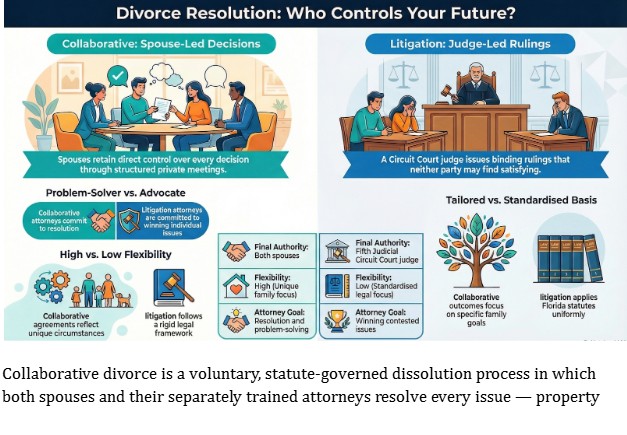
Collaborative divorce is a voluntary, statute-governed dissolution process in which both spouses and their separately trained attorneys resolve every issue — property division, alimony, parenting plans, and child support — through structured private meetings, so spouses retain direct control over every decision affecting their family.
Contested litigation is a court-supervised adversarial process in which a Fifth Judicial Circuit judge reviews evidence, hears arguments from opposing attorneys, and issues binding rulings on each unresolved issue.
That single distinction — who decides — drives every practical difference between the two paths.
In collaborative divorce, both spouses negotiate the marital settlement agreement directly, guided by their individual attorneys. Neither spouse hands their financial future or parenting arrangement to a third party with no knowledge of their family’s specific circumstances.
In contested litigation, the Hernando County Circuit Court judge assigned to the case issues rulings based on the evidence and legal arguments presented during hearings — rulings that neither party may find satisfying and that neither party can easily modify without filing a post-judgment motion.
| Decision Point | Collaborative Divorce | Contested Litigation |
| Who makes the final decisions | Both spouses, guided by trained collaborative attorneys | Fifth Judicial Circuit Court judge, Hernando County |
| Basis for decisions | Each family’s specific goals, finances, and parenting needs | Florida statutes and case law applied uniformly |
| Flexibility | High agreements can reflect unique family circumstances | Low — judge applies a standardized legal framework |
| Ability to appeal | Either party can file a post-judgment modification | Either party can file a post-judgment modification |
| Attorney’s role | Problem-solver committed to resolution | Advocate committed to winning individual issues |
Hernando County families who want to understand how Florida courts approach property division in contested cases should review the state’s equitable distribution standard under Florida Statutes § 61.075, which governs how a judge divides marital assets when spouses cannot agree.
Collaborative divorce replaces that judicial determination with a negotiated division both parties have directly shaped.
Cost Comparison: Collaborative Divorce vs. Litigation in Florida
Collaborative divorce costs less than contested litigation in the majority of Florida cases — not because collaborative attorneys charge lower rates, but because the collaborative process eliminates the most expensive phases of litigation: formal discovery, depositions, expert witness preparation, pre-trial motions, and trial itself.
Collaborative divorce cost breakdown (Florida, 2026):
- Attorney fees for both collaborative attorneys — billed at hourly rates throughout the four-way meeting process
- Neutral financial professional fees — typically $150–$300 per hour, jointly retained by both spouses
- Divorce coach or mental health professional fees — typically $150–$250 per hour when engaged for parenting discussions
- Filing fee with the Hernando County Clerk of Circuit Court — approximately $409 for dissolution with minor children
Florida Academy of Collaborative Professionals data from surveyed Florida collaborative professionals establishes these benchmarks:
- 24% of Florida collaborative cases cost $15,000 or less per person ($30,000 or less total)
- 55% of Florida collaborative cases cost $25,000 or less per person ($50,000 or less total)
- 29% of Florida collaborative cases cost between $25,000 and $50,000 per person
Contested litigation cost breakdown (Florida, 2026):
- Attorney’s hourly fees are billed throughout the entire case, from filing through trial
- Court filing fee — approximately $409 for dissolution with minor children
- Process server fees — $50–$60 for service of the petition
- Formal discovery costs — interrogatories, depositions at $300–$500 per hour of court reporter time, subpoenas
- Expert witness fees — financial analysts, vocational evaluators, real estate appraisers, and child psychologists each bill independently
- Guardian ad litem fees — appointed by the court when the judge determines minor children’s interests require separate representation
- Multiple hearing fees and related court costs throughout the case
| Cost Category | Collaborative Divorce | Contested Litigation |
| Total cost range per person | $7,500–$50,000 depending on complexity | $15,000–$100,000+ for complex contested cases |
| Discovery costs | None — voluntary disclosure replaces formal discovery | Substantial — interrogatories, depositions, subpoenas |
| Expert witness costs | Shared neutral professional, jointly retained | Each party retains independent experts, billed separately |
| Hearing fees | None during negotiation; uncontested final hearing only | Multiple hearings throughout — case management, temporary relief, trial |
| Timeline exposure | 4–12 months (attorney fees accumulate for that period) | 1–3 years (attorney fees accumulate for the entire contested period) |
| Predictability | Higher parties control the pace and scope of meetings | Lower — court scheduling delays and contested motions add cost unpredictably |
Families in Hernando County researching the direct financial comparison between mediation and litigation can also review the divorce mediation cost analysis for Florida on the Mulligan & Associates website, which covers court-connected mediation fees specific to the Fifth Judicial Circuit.
Not sure which path fits your budget and circumstances? Christopher Mulligan provides direct cost guidance during the initial consultation — call Mulligan & Associates at 352-593-5990 or contact us online to discuss your specific situation.
Timeline Comparison: How Long Each Process Takes in Florida
Collaborative divorce resolves faster than contested litigation in the substantial majority of Florida cases — not because collaborative divorce skips required legal steps, but because collaborative divorce eliminates court scheduling delays, contested motion practice, and trial preparation from the timeline entirely.
Collaborative divorce timeline in Florida:
Florida Academy of Collaborative Professionals data from surveyed Florida collaborative professionals establishes:
- 60% of Florida collaborative cases are completed within 6 months of the participation agreement signing date
- 90.7% of Florida collaborative cases are completed within 12 months
- Complex cases involving significant asset portfolios or highly contested parenting arrangements may extend to 18 months
Contested litigation timeline in Hernando County:
- Simple uncontested cases with no hearings: 30–90 days
- Moderately contested cases requiring case management conferences and mediation: 6–18 months
- Complex contested cases proceeding to trial in the Fifth Judicial Circuit: 18 months to 3 years, depending on court scheduling availability and the volume of contested issues
The Hernando County Circuit Court family division sets case management conferences, temporary relief hearings, and trial dates based on judicial calendar availability — a factor neither party controls.
Contested cases frequently extend beyond initial projections due to scheduling backlogs, emergency motions filed by either party, and the time required to complete formal financial discovery before trial can proceed.
Florida’s 20-day mandatory waiting period under Florida Statutes § 61.19 applies to every dissolution path — collaborative and contested alike.
In collaborative divorce, this waiting period rarely affects the overall timeline because most collaborative processes take longer than 20 days from participation agreement to final filing.
Privacy Comparison: Public Record vs. Confidential Process
Contested litigation in the Fifth Judicial Circuit generates a public case file. Every document filed with the Hernando County Clerk of Circuit Court — the Petition for Dissolution of Marriage, financial affidavits using Florida Family Law Form 12.902(b) or 12.902(c), parenting plan submissions, asset schedules, and hearing transcripts — becomes a public record accessible through the Hernando County Clerk’s online records portal.
Collaborative divorce produces a private process protected by statute. Florida Statutes § 61.60 establishes that all collaborative law communications — statements made in four-way meetings, financial information exchanged voluntarily, proposals offered during negotiation, and positions taken by either attorney — are confidential and privileged.
Neither party may introduce collaborative law communications as evidence in any subsequent litigation.
What this means practically for Hernando County families:
- Business owners whose financial records appear in a dissolution filing risk those records becoming accessible to competitors, clients, or employees through the Hernando County Clerk’s public portal
- Parents whose parenting disputes are litigated in open family court hearings produce a record that can be referenced in future modification proceedings.
- Professionals whose income and asset documentation appear in a public financial affidavit face potential exposure that they cannot retract after filing
Collaborative divorce limits public disclosure to the minimum required by Florida law — the final marital settlement agreement and the Final Judgment of Dissolution of Marriage filed to obtain judicial approval. Every negotiation, disclosure, and agreement reached in the process itself remains protected under Florida Statutes § 61.60.
When Collaborative Divorce Wins — And When Litigation Is the Right Answer
Collaborative divorce outperforms contested litigation on cost, timeline, privacy, and post-divorce relationship preservation in the majority of Hernando County family dissolutions.
However, collaborative divorce cannot succeed — and should not be attempted — in every situation. Recognizing which circumstances favor each path protects clients from choosing a process that cannot produce a durable outcome.
Collaborative divorce produces superior outcomes when:
- Both spouses commit to voluntary, complete financial disclosure under Florida Family Law Rule of Procedure 12.285 without requiring formal discovery to compel production
- Minor children are involved, and both parents prioritize maintaining a functional co-parenting relationship after dissolution — research published by the American Psychological Association consistently identifies parental conflict during dissolution as the primary factor in children’s post-divorce adjustment difficulties
- The marital estate includes complex financial instruments — defined benefit pension plans requiring a Qualified Domestic Relations Order under 29 U.S.C. § 1056(d), closely held business interests, investment portfolios, or multiple real property holdings — that benefit from neutral financial professional analysis
- Both spouses want to control the parenting plan rather than have a Hernando County Circuit Court judge determine time-sharing schedules and parental decision-making authority
- Privacy matters to either spouse professionally, reputationally, or personally
Contested litigation is the appropriate path when:
- Domestic violence, threats, or a documented power imbalance exists — Florida Statutes § 61.57 mandates domestic violence screening before any collaborative participation agreement is signed, and the presence of domestic violence typically makes voluntary negotiation unsafe, regardless of screening
- One spouse is concealing marital assets, underreporting income, or refusing to comply with Florida Family Law Rule of Procedure 12.285 financial disclosure requirements — contested litigation provides formal discovery tools, including depositions, subpoenas, and forensic accounting, that collaborative divorce does not.
- One spouse requires immediate judicial relief — emergency temporary child support, a domestic violence injunction under Florida Statutes § 741.30, or an emergency custody modification — that a collaborative process cannot provide
- One spouse has retained litigation-focused counsel and filed a contested petition, signaling that voluntary negotiation is not a realistic path to resolution.n
Christopher Mulligan at Mulligan & Associates handles both collaborative dissolutions and fully contested divorce proceedings in Hernando County.
Mulligan evaluates each client’s specific circumstances — including the opposing spouse’s likely behavior, the financial complexity of the marital estate, and the parenting issues in dispute — and recommends the dissolution path that produces the most durable outcome with the most effective legal protection.
Families navigating situations where one spouse has already received or is seeking a restraining order should review Brooksville restraining order representation alongside their dissolution strategy, since the presence of an injunction directly affects which dissolution path is viable.
What Collaborative Divorce vs. Litigation Means for Hernando County Parents
The dissolution path chosen by Hernando County parents directly determines how the parenting plan is written, how time-sharing disputes are resolved, and how child support is calculated — producing materially different outcomes for children depending on which process the parents use.
In collaborative divorce, both parents negotiate the parenting plan directly in four-way meetings, often with a collaboratively trained mental health professional facilitating child-specific discussions.
The resulting parenting plan addresses the time-sharing schedule, parental decision-making authority over healthcare and education, the method of communication parents will use with their child, and procedures for resolving future parenting disputes — all as required by Florida Statutes § 61.29.
Parents who negotiate their own parenting plan produce more specific, tailored, and durable arrangements than those issued after contested custody hearings.
In contested litigation, the Hernando County Circuit Court judge reviews parenting plan submissions from each parent’s attorney, hears testimony from both parents, and issues a time-sharing order based on the best interests of the child standard under Florida Statutes § 61.13. Neither parent controls the outcome.
The judge applies the statutory best-interests factors uniformly — without the granular knowledge of the family’s daily routines, the child’s specific needs, or the parents’ work schedules that direct parental negotiation produces.
Hernando County parents with pending child custody disputes should review Florida’s time-sharing and parenting plan requirements with Christopher Mulligan before deciding between collaborative divorce and litigation.
The dissolution path selected at the outset shapes how every custody and child support issue gets resolved — and how difficult future modifications become.
Florida also requires both parents to complete a Supreme Court-approved parenting education and family stabilization course under Florida Statutes § 61.21 before the court schedules a final hearing in any dissolution involving minor children, regardless of whether the path is collaborative or contested.
Mulligan & Associates serves Brooksville, Spring Hill, Citrus Springs, and all of Hernando County. Call 352-593-5990 or schedule your consultation with Christopher Mulligan today — the initial conversation is confidential and carries no obligation to proceed.
Frequently Asked Questions
Is collaborative divorce better than going to court in Florida?
Collaborative divorce outperforms litigation on cost, timeline, privacy, and co-parenting outcomes for most Hernando County families. The Florida Academy of Collaborative Professionals reports 85.1% of Florida collaborative cases reach full agreement. Litigation is better when domestic violence or hidden assets make voluntary negotiation unsafe.
How much cheaper is collaborative divorce than litigation in Florida?
Collaborative divorce typically costs $7,500–$25,000 per person versus $15,000–$100,000 or more for contested litigation. The Florida Academy of Collaborative Professionals reports 55% of Florida collaborative cases cost $25,000 or less per person, primarily because collaborative divorce eliminates depositions, formal discovery, expert witnesses, and trial.
What happens if collaborative divorce fails in Florida?
When a collaborative divorce fails in Florida, Florida Statutes § 61.57 requires both collaborative attorneys to withdraw immediately. Both spouses must hire new litigation counsel before proceeding to court, restarting the attorney relationship entirely and adding both time and cost to the overall dissolution.
Is a Florida divorce a public record?
Yes. Every document filed in a contested Hernando County dissolution — including financial affidavits, asset schedules, and parenting disputes — becomes a public record accessible through the Hernando County Clerk portal. Collaborative divorce communications are confidential and privileged under Florida Statutes § 61.60, protecting financial and personal details from public disclosure.
How long does a contested divorce take in Florida compared to a collaborative one?
Contested litigation in Hernando County takes one to three years for complex cases. The Florida Academy of Collaborative Professionals reports 60% of Florida collaborative divorces are completed within six months and 90.7% within twelve months — because collaborative divorce eliminates court scheduling delays, contested motions, and trial preparation entirely.
Can you get temporary support or a restraining order in a collaborative divorce?
No. Collaborative divorce cannot produce emergency court orders. Spouses requiring temporary child support, domestic violence injunctions under Florida Statutes § 741.30, or emergency custody modifications must pursue contested litigation to access those court-ordered protections. Christopher Mulligan at Mulligan & Associates handles both paths — call 352-593-5990 to discuss your options.
Does collaborative divorce go to court in Florida?
Collaborative divorce requires only one court appearance — an uncontested final hearing at which the Hernando County Circuit Court judge reviews the executed marital settlement agreement and enters the Final Judgment of Dissolution of Marriage. No contested testimony, no hearings, no trial — the process reaches the judge only at the finish line.
When does litigation protect you better than collaborative divorce in Florida?
Litigation protects spouses better than collaborative divorce when one party conceals assets, refuses financial disclosure, or participates in bad faith, because contested litigation provides depositions, subpoenas, and forensic accounting tools that the collaborative process lacks. Domestic violence, active injunctions, and emergency custody situations also require litigation’s immediate court-ordered protections.

About the Author
Christopher S. Mulligan
Florida Bar Member in Good Standing since November 9, 2007 (Bar No. 47524) · J.D., The George Washington University Law School, 2006
Christopher S. Mulligan is a third-generation Florida attorney and founder of Mulligan & Associates in Brooksville, Florida. He drafted provisions of the 2005 Violence Against Women Act reauthorization and serves as a Guardian ad Litem and Attorney ad Litem for children in foster care. He has practiced family law in Hernando County since 2007 and represents families in divorce, custody, support, adoption, dependency, and injunction matters throughout the Fifth Judicial Circuit.