
Collaborative Divorce Options in Brooksville & Hernando County, FL: A Complete Guide

Data last verified: March 2026
Couples in Brooksville and Hernando County have four primary divorce options that avoid full courtroom litigation: collaborative divorce, mediation, uncontested divorce, and cooperative negotiation. Each path differs in cost, timeline, attorney involvement, and the degree of court oversight.
If you are considering ending your marriage in Hernando County, you do not have to walk into a courtroom and fight.
Florida law gives couples real choices, and the right choice depends on your assets, your children, your relationship with your spouse, and how much control you want to keep over the outcome.
Mulligan & Associates has served Brooksville, Spring Hill, and Hernando County families in every type of dissolution since 2007, and attorney Christopher Mulligan understands which path best protects clients at every level of conflict.
Reach out to our Brooksville divorce team today to discuss which option fits your situation.
This guide explains all four non-adversarial divorce paths available in Florida, how they compare in real terms, and what the process looks like inside the Hernando County court system.
Key Takeaways
- Florida law permits divorce through four non-adversarial paths: collaborative divorce, mediation, uncontested divorce, and cooperative negotiation — each with distinct costs, timelines, and levels of attorney involvement.
- Couples in Hernando County must meet Florida’s six-month residency requirement under Florida Statutes § 61.021 before filing a Petition for Dissolution of Marriage with the Hernando County Clerk of Circuit Court.
- Collaborative divorce in Florida is governed by the Uniform Collaborative Law Act, codified at Florida Statutes §§ 61.55–61.58, and requires both spouses to retain separately trained collaborative attorneys.
- Choosing the right divorce path early protects your rights, your children, and your financial future — and avoids unnecessary court costs at the Hernando County Courthouse at 20 N. Main Street, Brooksville.
What Are Your Divorce Options in Hernando County, Florida?
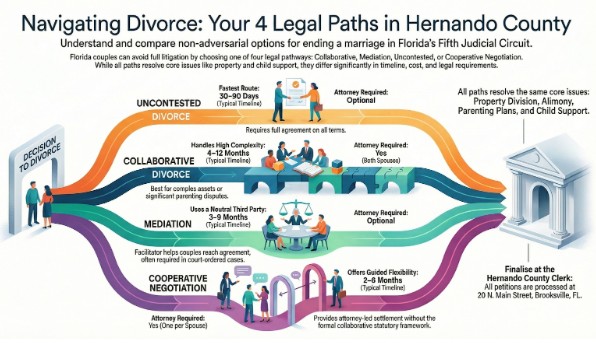
Florida couples have four recognized paths to end a marriage without full adversarial litigation. Each path resolves the same core legal issues — property division, alimony, parenting plans, and child support — but through different processes, with different levels of attorney involvement and court oversight.
The four options are collaborative divorce, mediation, uncontested divorce, and cooperative negotiation.
Collaborative divorce is a formal, structured process governed by Florida statute. Mediation uses a neutral third party to facilitate an agreement.
An uncontested divorce requires a full pre-filing agreement between the spouses. Cooperative negotiation is an attorney-guided settlement outside the formal collaborative framework.
| Divorce Path | Court Involvement | Attorney Required | Typical Timeline | Best For |
| Collaborative Divorce | Minimal — final approval only | Yes — both spouses | 4–12 months | Complex assets, parenting disputes, desire for structured process |
| Mediation | Moderate — mediator + judge signs off | Optional but recommended | 3–9 months | Court-ordered cases, couples who need a neutral facilitator |
| Uncontested Divorce | Low — judge reviews settlement | Optional | 30–90 days | Full agreement on all terms, simple asset picture |
| Cooperative Negotiation | Low to moderate | Yes — negotiates on your behalf | 2–8 months | Those who want attorney guidance without a formal collaborative structure |
Florida’s Fifth Judicial Circuit, which includes Hernando County, handles all family law proceedings. The Hernando County Clerk of Circuit Court, located at 20 N. Main Street, Brooksville, FL 34601, processes all petitions, financial affidavits, and final judgments regardless of which path you choose.
Ready to explore your divorce options in Hernando County? Call Mulligan & Associates at 352-593-5990 or schedule a consultation with Christopher Mulligan today.
What Is Collaborative Divorce in Florida?
Collaborative divorce is a formal, attorney-guided process in which both spouses and their separately retained attorneys sign a participation agreement committing all parties to resolve the dissolution without litigation.
Florida enacted the Uniform Collaborative Law Act at Florida Statutes §§ 61.55–61.58, thereby establishing collaborative divorce as a clearly defined legal process in this state.
The process centers on a series of four-way meetings — both spouses and both attorneys present simultaneously — focused on reaching a full marital settlement agreement.
Additional team members may include a neutral financial professional and a mental health coach, depending on the case’s complexity.
How the Collaborative Divorce Process Works in Florida:
- Both spouses retain separately trained collaborative attorneys.
- All four parties sign a participation agreement, which includes a disqualification clause — if collaboration fails, both attorneys must withdraw, and new litigation counsel must be retained.
- Four-way meetings are scheduled to address each issue: property division under Florida’s equitable distribution standard, alimony, parenting plan, and child support.
- A neutral financial professional may be brought in to conduct a complex asset analysis.
- A mental health coach may assist where parenting or communication conflicts arise.
- Once all issues are resolved, attorneys draft the marital settlement agreement and parenting plan.
- The agreement is filed with the Hernando County Clerk of Circuit Court for judicial review and final judgment.
The disqualification clause is the element that gives collaborative divorce its integrity. Because both attorneys would lose the case if negotiations fail, all parties are genuinely committed to reaching a resolution.
This structure produces more durable agreements and significantly fewer post-divorce modifications.
| Collaborative Divorce Element | Florida Requirement |
| Governing statute | Florida Statutes §§ 61.55–61.58 |
| Participation agreement | Mandatory — signed by all four parties |
| Disqualification clause | Mandatory — both attorneys must withdraw if collaboration fails |
| Attorney training | Both attorneys must be trained in collaborative law |
| Court involvement | Final judgment only — no contested hearings |
| Parenting plan | Required under Florida Statutes § 61.29 when minor children are involved |
Families in Brooksville and Spring Hill who have children benefit most from this structure. The collaborative process keeps parenting decisions in the hands of parents, not a Hernando County Circuit Court judge.
For families with complex assets, retirement accounts, or business interests, the neutral financial professional adds a level of analysis that courtroom proceedings rarely match.
What Is Divorce Mediation in Florida, and When Does Hernando County Require It?
Divorce mediation in Florida is a process in which a neutral, Florida Supreme Court-certified mediator facilitates negotiation between spouses to reach a marital settlement agreement.
The mediator does not represent either party, cannot give legal advice, and cannot make binding decisions. Mediators help spouses communicate — they do not decide outcomes.
Florida courts in the Fifth Judicial Circuit frequently require mediation before a contested divorce can proceed to trial.
Hernando County Circuit Court judges routinely issue mediation orders in contested family law cases, meaning many families encounter mediation whether they planned for it or not.
There are two types of mediation available in Hernando County:
Court-Connected Mediation is ordered by the circuit court and conducted through the court’s mediation program. Fees are set on a sliding scale based on income, making this option accessible to lower-income families.
Private Mediation is arranged directly by the parties and their attorneys outside the court system. Private mediators typically charge hourly rates but offer greater scheduling flexibility and more experienced facilitators for complex cases.
Having an attorney represent you in mediation is not legally required in Florida, but it matters significantly. A mediator cannot tell you whether a proposed settlement protects your legal rights.
Attorney Christopher Mulligan regularly represents Hernando County clients through mediation — reviewing proposed terms, advising on Florida’s equitable distribution rules under Florida Statutes § 61.075, and ensuring that any mediated agreement is enforceable before it is signed.
A mediated agreement becomes legally binding once both spouses sign the written settlement, the document is filed with the Hernando County Clerk of Circuit Court, and the Circuit Court judge enters it as a final judgment of dissolution.
What Is an Uncontested Divorce in Florida, and Who Actually Qualifies?
An uncontested divorce in Florida is available when both spouses have already reached full agreement on every issue — property division, debt allocation, alimony, the parenting plan, and child support — before filing with the Hernando County Clerk of Circuit Court.
Florida law provides two tracks: the regular uncontested dissolution and the simplified dissolution of marriage.
The simplified dissolution of marriage under Florida Statutes § 61.172 is the faster path, but it is only available when both spouses have no minor children together, neither party is pregnant, both waive the right to alimony, both agree to the division of all assets and debts, and both waive the right to trial and appeal.
When children are involved, a regular uncontested dissolution applies, and Florida mandates a parenting plan and completion of a parenting education course under Florida Statutes § 61.21.
What Uncontested Divorce Requires in Hernando County:
- Florida residency for at least six months by at least one spouse
- Completed Petition for Dissolution of Marriage
- Financial affidavits from both parties
- Marital settlement agreement covering all issues
- Parenting plan (if minor children are involved)
- Certificate of completion of a Florida-approved parenting education course (if minor children are involved)
- Filing fee paid to the Hernando County Clerk of Circuit Court
The filing fee for a dissolution of marriage in Hernando County is currently approximately $409, subject to change — verify the current amount directly with the Hernando County Clerk at 20 N. Main Street, Brooksville, before filing.
An uncontested divorce sounds simple. In practice, the most common reason uncontested cases stall or become contested is incomplete financial disclosure or a parenting plan that does not meet Florida’s statutory requirements.
Attorney Christopher Mulligan regularly reviews uncontested agreements for Hernando County families to identify issues before they become court problems.
Reviewing custody arrangements is a service our child custody team handles alongside dissolution matters.
Not sure whether collaborative divorce, mediation, or an uncontested filing is right for your family? Mulligan & Associates serves Brooksville, Spring Hill, and all of Hernando County — contact our team to get clarity before you commit to a path.
What Is Cooperative Divorce, and How Does It Differ from Collaborative?
Cooperative divorce is an attorney-guided settlement negotiation conducted outside the formal collaborative law framework. Both spouses retain attorneys who negotiate on their behalf — by phone, letter, and direct meeting — with the goal of reaching a marital settlement agreement without a court trial.
Unlike collaborative divorce, cooperative negotiation does not require a participation agreement, does not include a disqualification clause, and does not bind attorneys to withdraw if negotiations fail.
This distinction matters. In cooperative negotiation, your attorney can continue to represent you in litigation if negotiations break down.
That flexibility makes cooperative divorce a practical choice for couples who want attorney representation and a structured negotiation process but are not ready to commit to the formal collaborative framework.
Cooperative divorce works well when both spouses are willing to negotiate in good faith, one or both spouses have significant legal needs that benefit from direct attorney representation, the financial picture is straightforward enough to resolve without a neutral financial professional, and the parenting arrangement is largely agreed upon but requires legal drafting.
The cooperative path is not appropriate when one spouse is concealing assets, domestic violence is a factor, or one party is actively non-cooperative.
In those situations, the formal protections of collaborative divorce or the court’s intervention through litigation provide stronger safeguards.
If you are unsure which path fits your circumstances, speak directly with Christopher Mulligan — the consultation is the starting point for making that determination clearly and without pressure.
Which Divorce Option Is Right for Your Family in Hernando County?
The right divorce path depends on five factors: the level of conflict between spouses, the complexity of your finances, whether children are involved, your timeline, and your budget.
Most families in Brooksville and Spring Hill can quickly narrow their options once they understand what each path requires of them.
| Your Situation | Recommended Path |
| Full agreement on all terms, no children, minimal assets | Uncontested — Simplified Dissolution |
| Full agreement, children involved, can handle the required paperwork | Uncontested — Regular Dissolution |
| Some disagreements, both want to avoid court, and are willing to negotiate | Mediation with attorney representation |
| Complex finances, children, want a structured process with no court | Collaborative Divorce |
| Attorney-guided negotiation preferred, formal process not needed | Cooperative Negotiation |
| One spouse is uncooperative, hiding assets, or there is domestic violence | Contested Litigation |
Cost and timeline are real factors. Uncontested divorces in Hernando County typically take 30 to 90 days to finalize once the paperwork is complete.
Collaborative divorces typically take four to twelve months but produce more comprehensive and durable outcomes for complex families. Mediation timelines vary — court-ordered mediation in Hernando County is generally completed within three to six months of the order.
The Hernando County Circuit Court at 20 N. Main Street, Brooksville, handles all final judgments regardless of path. Even a fully uncontested divorce ultimately requires a judge’s signature.
The difference between paths lies in how much of the work — and the decisions — occurs before the case ever reaches that judge.
Christopher Mulligan and the team at Mulligan & Associates serve clients throughout Hernando County, including Brooksville, Spring Hill, Citrus Springs, and Homosassa Springs.
If you are a family law client in Spring Hill or Homosassa Springs, our attorneys are familiar with the specific procedures and judicial expectations of the Fifth Judicial Circuit.
Families navigating child support alongside divorce will find that the path chosen for dissolution directly affects how support is calculated and enforced.
Florida Legal Requirements Every Divorcing Couple Must Know
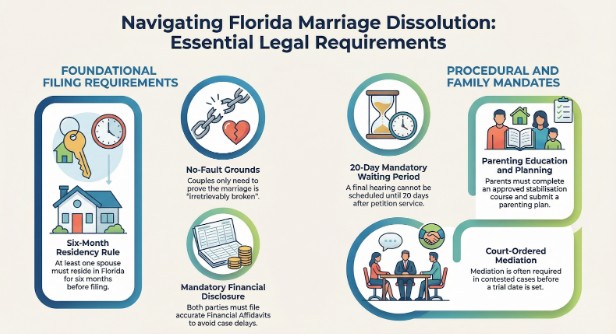
Florida imposes several non-waivable legal requirements on every dissolution of marriage, regardless of the path chosen.
Failing to meet these requirements stalls the case and, in some instances, voids agreements already signed.
Residency: At least one spouse must have resided in Florida for a minimum of six months immediately before filing, per Florida Statutes § 61.021. Proof of residency — typically a Florida driver’s license or voter registration card — must be produced.
Grounds: Florida is a no-fault divorce state. The only required legal ground is that the marriage is “irretrievably broken.” Neither party is required to prove misconduct.
Financial Disclosure: Both spouses must complete and file a Financial Affidavit with the Hernando County Clerk of Circuit Court. Florida Family Law Rules of Procedure Forms 12.902(b) and 12.902(c) apply depending on income level. Incomplete or inaccurate financial affidavits are among the most common causes of case delay in Hernando County.
Parenting Requirements (when children are involved):
- A written parenting plan is mandatory under Florida Statutes § 61.29, governing time-sharing, decision-making authority, and communication between parents.
- Both parents must complete a Florida Supreme Court-approved parenting education and family stabilization course under Florida Statutes § 61.21 before the final hearing.
Waiting Period: Florida imposes a 20-day mandatory waiting period from the date the petition is served before a final hearing can be scheduled, per Florida Statutes § 61.19. This waiting period applies to all dissolution paths.
Mediation (when ordered by the court): Hernando County Circuit Court judges order mediation in contested cases routinely before any trial date is set. Parties who appear for mediation without legal representation frequently reach agreements they later regret.
The Florida Dispute Resolution Center maintains a list of Florida Supreme Court-certified mediators serving Hernando County.
Why Work With Mulligan & Associates on Your Hernando County Divorce
Mulligan & Associates is a Brooksville-based family law firm serving Hernando County families since 2007.
Attorney Christopher Mulligan is a third-generation Florida attorney who earned his Juris Doctor from The George Washington University Law School and has represented Hernando County families through every type of dissolution — from simple uncontested cases to high-conflict litigation involving custody, dependency, and restraining orders.
The firm handles the full spectrum of family law in Hernando County.
Divorce cases frequently involve related matters — child custody arrangements, child support calculations, dependency proceedings, and restraining orders — and having a single firm handle all connected matters is more efficient and less costly than coordinating between multiple attorneys.
Clients in Citrus Springs, Spring Hill, Homosassa Springs, and throughout Hernando County receive the same hands-on representation from Christopher Mulligan that Brooksville clients receive — including in-person consultations and direct attorney access throughout their case.
Call Mulligan & Associates at 352-593-5990 or schedule a consultation online to discuss your divorce options. The conversation is confidential, and there is no obligation to proceed.
Frequently Asked Questions
What is the difference between collaborative divorce and mediation in Florida?
Collaborative divorce is a formal, attorney-led process governed by Florida Statutes §§ 61.55–61.58, in which both spouses retain trained collaborative attorneys and sign a binding participation agreement. Mediation uses a neutral facilitator with no decision-making authority. Both paths avoid courtroom litigation, but collaborative divorce provides structured attorney representation throughout, while mediation relies on the parties to negotiate directly.
Does Florida require mediation before a divorce can be finalized?
Florida courts do not require mediation in every dissolution case, but Hernando County Circuit Court judges order mediation in contested matters routinely before scheduling a trial. Under Florida Family Law Rules of Procedure Rule 12.740, courts have broad authority to refer family law cases to mediation at any stage. Couples who pursue uncontested or collaborative divorce typically avoid court-ordered mediation entirely.
How long does an uncontested divorce take in Hernando County?
An uncontested divorce in Hernando County typically takes 30 to 90 days from the date the petition is filed with the Hernando County Clerk of Circuit Court. The actual timeline depends on how quickly both parties complete and file required documents — including financial affidavits and, when children are involved, the parenting plan and parenting education course certificate — and on the court’s current scheduling availability.
What does a parenting plan need to include in Florida?
A Florida parenting plan must address the division of daily tasks and responsibilities, the time-sharing schedule, which parent has decision-making authority over healthcare, education, and extracurricular activities, and the method and technology parents will use to communicate with their child and with each other, as set forth in Florida Statutes § 61.29.
Can one spouse refuse to participate in collaborative divorce?
Yes. Collaborative divorce in Florida requires voluntary participation from both spouses. If one spouse refuses to sign the participation agreement, the collaborative process cannot begin. In those situations, mediation, cooperative negotiation, or contested litigation may be the appropriate alternative. Attorney Christopher Mulligan can advise on which path is viable given your spouse’s willingness to cooperate.
What happens if collaborative divorce negotiations fail?
If collaborative divorce negotiations break down, the participation agreement’s disqualification clause takes effect. Both collaborative attorneys must withdraw from representation, and both spouses must retain new litigation counsel before the case can proceed to contested court proceedings. This requirement is mandatory under Florida Statutes § 61.57.
What is the filing fee for divorce in Hernando County?
The current filing fee for a Petition for Dissolution of Marriage in Hernando County is approximately $409 for cases with minor children and $409 for cases without minor children, though fees are subject to change. Verify current amounts directly with the Hernando County Clerk of Circuit Court at 20 N. Main Street, Brooksville, FL 34601, or by calling the Clerk’s office before filing. Fee waivers are available for qualifying low-income parties.
Is Florida a no-fault divorce state?
Yes. Florida is a no-fault divorce state under Florida Statutes § 61.052. The only legally required ground for dissolution is that the marriage is “irretrievably broken.” Neither spouse is required to prove adultery, abandonment, cruelty, or any other marital fault to obtain a divorce. This applies equally to all four dissolution paths — collaborative, mediation, uncontested, and cooperative.
Do both spouses need a lawyer for an uncontested divorce in Florida?
Florida law does not require either spouse to retain an attorney for an uncontested divorce. However, a review of the marital settlement agreement by a family law attorney before filing is strongly advisable. Errors in financial affidavits, incomplete parenting plans, or improperly drafted property division terms frequently cause delays in cases or create enforceability issues post-judgment.
What is the residency requirement for divorce in Florida?
At least one spouse must have been a Florida resident for a minimum of six months immediately preceding the filing of the Petition for Dissolution of Marriage, as required by Florida Statutes § 61.021. Only one spouse needs to meet this requirement — the other spouse may be a resident of a different state or country. Proof of Florida residency, typically a Florida driver’s license or Florida voter registration card, is required at the time of filing.
Can a cooperative divorce become contested later?
Yes. Because cooperative divorce does not include a formal participation agreement or disqualification clause, either party may escalate to contested litigation if negotiations break down. This is a key distinction from collaborative divorce, in which the disqualification clause creates a structural commitment to the non-adversarial process.
About the Author
Christopher S. Mulligan
Florida Bar Member in Good Standing since November 9, 2007 (Bar No. 47524) · J.D., The George Washington University Law School, 2006
Christopher S. Mulligan is a third-generation Florida attorney and founder of Mulligan & Associates in Brooksville, Florida. He drafted provisions of the 2005 Violence Against Women Act reauthorization and serves as a Guardian ad Litem and Attorney ad Litem for children in foster care. He has practiced family law in Hernando County since 2007 and represents families in divorce, custody, support, adoption, dependency, and injunction matters throughout the Fifth Judicial Circuit.