
Violating a Protection Order in Florida: Penalties, Defenses & What Happens Next
Reviewed by Christopher S. Mulligan, Esq., a Brooksville family law attorney since 2007 whose practice includes injunction, contempt, and related criminal matters in the Hernando County courts.
Violating a protection order in Florida means willfully breaking the terms of an injunction for protection, such as contacting the petitioner, going near a protected location, or keeping firearms the court ordered surrendered.
A first violation is usually a first-degree misdemeanor, and the court can also punish it through contempt.
Mulligan & Associates, P.A., a Brooksville, Florida family law firm, handles restraining order cases for petitioners and respondents in Hernando County.
Key Takeaways
- Willfully violating a domestic violence injunction is a first-degree misdemeanor under Fla. Stat. §741.31(4)(a), punishable by up to 1 year in jail and a $1,000 fine.
- A domestic violence injunction violation becomes a third-degree felony under Fla. Stat. §741.31(4)(c) when a respondent with a prior conviction for domestic violence or an injunction violation commits a new violation against the same victim; an arrest or pending case is not a conviction.
- Fla. Stat. §901.15(6) lets officers arrest without a warrant on probable cause, and under §741.29(4) a domestic violence arrest does not require the victim’s consent.
- A petitioner without an arrest can file an affidavit of violation with the circuit court clerk, and the state attorney has 30 working days to act.
A violation accusation can mean arrest within hours. Mulligan & Associates explains the charge, the hearing, and each available option. Talk with the firm today.
What Counts as Violating a Protection Order in Florida?
A violation is a willful act that breaks a term of a Florida injunction for protection after the respondent knows about it. Three statutes list the prohibited acts, and the lists closely match.
The acts that count as violations under Fla. Stat. §741.31 include:
- Direct or third-party contact: calling, texting, emailing, messaging on social media, or sending word through another person, unless the order specifically allows indirect contact through a third party.
- Proximity: going to or within 500 feet of the petitioner’s home, school, workplace, or another place named in the order, or knowingly coming within 100 feet of the petitioner’s car.
- Violence or threats: committing violence against the petitioner or making an intentional unlawful threat.
- Property: damaging or destroying the petitioner’s belongings, including a vehicle.
- Firearms: refusing to surrender firearms or ammunition when the court orders it.
- Residence: refusing to leave a shared home after the order requires it.
Each order also carries its own terms, so the exact wording controls.
Penalties by Injunction Type
| Injunction Type | Violation Statute | First Violation | Felony Trigger |
| Domestic violence | Fla. Stat. §741.31 | First-degree misdemeanor | One prior conviction for domestic violence or an injunction violation, then a new violation against the same victim |
| Repeat, dating, or sexual violence | Fla. Stat. §784.047 | First-degree misdemeanor | Two prior convictions for violating an injunction, then a new violation against the same victim |
| Stalking or cyberstalking | Fla. Stat. §784.0487 | First-degree misdemeanor | Two prior convictions for violating an injunction, then a new violation against the same victim |
In each statute, a conviction means a finding of guilt after a plea or trial, even when adjudication is withheld, or the plea is no contest. Arrests and pending charges do not count toward the felony threshold.
Is a Protection Order Violation a Crime or Civil Contempt?
A Florida protection order violation can follow either track, and sometimes both, in Hernando County family court and criminal court.
Under Fla. Stat. §741.30(9)(a), the court can enforce the order through civil or criminal contempt, while the state attorney can separately prosecute the violation as a crime.
| Enforcement Track | Who Starts It | Purpose | Possible Outcome |
| Criminal charge | State attorney, often after an arrest | Punish a past violation | Conviction, jail, fines, probation, and a criminal record |
| Criminal contempt | Court, usually through an order to show cause prosecuted by the state attorney | Punish disobedience of the court’s order | Jail or fines imposed by the judge |
| Civil contempt | Court, often on the petitioner’s motion | Force future compliance | Sanctions that end once the respondent complies, plus monetary assessments |
Under Fla. Stat. §741.31(2), the state attorney has 30 working days after receiving an affidavit of violation to file criminal charges, seek criminal contempt, pursue both in the alternative, or report that the matter is still under investigation or pending.
That deadline governs a report, not a guaranteed charge, hearing date, or outcome.
These stages are also distinct. An arrest is a law enforcement action; a charge is the state attorney’s formal accusation; a contempt finding is a judge’s ruling on the court’s own order; and a conviction is a finding of guilt after a plea or trial.
A respondent can be arrested without being charged, and charged without being convicted.
What Are the Penalties for Violating a Protection Order in Florida?
A first violation is a first-degree misdemeanor carrying up to 1 year in jail and a fine of up to $1,000. A violation that crosses the felony threshold in the table above becomes a third-degree felony, punishable by up to 5 years in prison and a $5,000 fine.
The criminal sentence is only one part of the exposure:
- Batterers’ intervention: when a court finds a willful violation of a domestic violence injunction, Fla. Stat. §741.31(5) requires it to order a batterers’ intervention program unless it explains in writing why the program does not fit.
- Civil damages: the court that issued the injunction can award the petitioner economic damages for injury or loss, including enforcement costs and attorney fees.
- Firearms: Fla. Stat. §790.233 makes possessing a firearm or ammunition while subject to a final domestic violence or stalking injunction a first-degree misdemeanor. Federal law, 18 U.S.C. §922(g)(8), reaches only orders entered after a hearing the respondent had notice of and a chance to attend, protecting an intimate partner (a current or former spouse, a co-parent, or a current or former cohabitant) or a child, and either finding a credible threat or expressly barring physical force. Temporary ex parte orders and orders between people without that relationship fall outside it, so the state and federal bans do not always overlap. A knowing federal violation carries up to 15 years under 18 U.S.C. §924(a)(8).
- Custody: evidence of domestic violence can affect time-sharing under Fla. Stat. §61.13.
What Should a Petitioner Do When a Protection Order Is Violated?
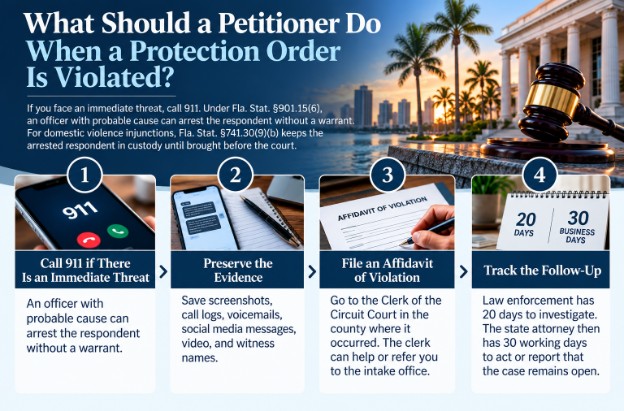
A petitioner facing an immediate threat should call 911 first. Under Fla. Stat. §901.15(6), an officer with probable cause can arrest the respondent without a warrant.
For domestic violence injunctions, Fla. Stat. §741.30(9)(b) keeps the arrested respondent in custody until brought before the court.
In a non-emergency, these steps protect the record:
- Preserve the evidence. Save screenshots with visible dates, call logs, voicemails, social media messages, doorbell or dashcam video, and witness names.
- Avoid replying. Responding to the respondent can blur the record and complicate the case.
- File an affidavit of violation. If no arrest happened, the petitioner can go to the Clerk of the Circuit Court in the county where the violation occurred. The clerk can help prepare the affidavit or refer the petitioner to the court’s designated intake office.
- Track the follow-up. Law enforcement has 20 days to finish its investigation and report to the state attorney, who then has 30 working days to act or report that the case remains open. Neither deadline guarantees a charge or a court date.
Only a judge can change or end the order. A petitioner who wants contact restored needs to ask the court to modify or dissolve the injunction, because informal agreements leave the respondent exposed to arrest.
Parents who also need immediate parenting relief can file an emergency custody motion in Hernando County.
What Happens to a Respondent Accused of Violating a Protection Order?
A respondent arrested for violating a domestic violence injunction stays in custody until brought before a judge, who addresses release conditions. Any criminal case and contempt proceeding then run on separate schedules.
The state must prove the violation was willful, so the facts matter. Common defense issues include the following.
No Notice of the Order
Florida punishes only willful violations, so the state must prove the respondent knew the order existed and what it prohibited. Formal service by a deputy is the usual proof, and in Hernando County the steps after filing often move from petition to service within a few days.
Service is not the only possible proof, though, because evidence that the respondent learned the terms another way may also be offered. Missing or defective service is a question to examine, not an automatic defense.
Accidental or Incidental Contact
An unplanned encounter, such as both parties arriving at the same store, is not automatically a crime.
A respondent who leaves promptly and makes no contact has a stronger argument that nothing willful happened. Staying, speaking, or following the petitioner quickly weakens that argument.
Hypothetical example: A respondent walks into a Brooksville grocery store, sees the petitioner in the produce aisle, and leaves within a minute without speaking.
A respondent who instead follows the petitioner to the parking lot or waits by the car presents a very different set of facts, which a court may view as willful. The order’s exact terms and the evidence decide how a judge sees either situation.
Contact the Order Allows
Many orders allow communication about children, exchanges at a set location, or contact through attorneys, and messages within those limits aren’t violations.
Unsupported or False Allegations
Screenshots can be edited, and accounts spoofed, so phone records, location data, and metadata often decide whether an accusation holds up.
When Should Someone Call a Brooksville Protection Order Violation Attorney?
The best time to call a Brooksville protection order violation attorney is before the first court date, whether the client is the petitioner or the respondent. Bringing the right documents to the first meeting saves time:
- Petitioners: a copy of the injunction, screenshots and call logs, any police report or case number, and witness names.
- Respondents: the injunction and proof of service, arrest or bond paperwork, messages showing context, and any order provision allowing contact.
Christopher S. Mulligan has practiced family law in Brooksville since 2007 and represents clients in injunction, custody, contempt, and related criminal matters before the Hernando County courts.
Petitioners get help filing affidavits and enforcement motions, and respondents get a careful review of the evidence before any plea or hearing.
Violation cases move fast on two tracks. Mulligan & Associates reviews the order, the evidence, and the next hearing date. Schedule a consultation.
Frequently Asked Questions
Is violating a restraining order a felony in Florida?
Usually not on a first offense, which is a first-degree misdemeanor. A violation becomes a third-degree felony after prior qualifying convictions involving the same victim: one prior for domestic violence injunctions, or two for repeat, dating, sexual violence, or stalking injunctions.
Can someone go to jail for violating a protection order in Florida?
Yes. A first-degree misdemeanor carries up to 1 year in county jail, and a felony violation carries up to 5 years in prison. Judges can also jail a respondent for criminal contempt, and a respondent arrested on a domestic violence injunction stays jailed until first appearance.
Is a text message a violation of an injunction in Florida?
Yes, when the order prohibits contact. Florida’s violation statutes cover direct and indirect communication, including texts, calls, emails, and social media messages. Messages sent through friends or relatives also count unless the injunction specifically allows indirect contact through a third party.
What happens if the petitioner contacts the respondent first?
The injunction still binds the respondent. Florida courts generally treat the order as controlling until a judge modifies or dissolves it, so responding to a petitioner’s message can still support a violation charge. A respondent should save the petitioner’s message and avoid replying.
Can a petitioner drop charges for violating an injunction?
No. The state attorney, not the petitioner, decides whether to prosecute a violation, and officers can arrest even when the petitioner objects. A petitioner can share concerns with the prosecutor, but the state decides whether to continue or dismiss.
What if a respondent accidentally runs into the petitioner?
An accidental encounter is not automatically a crime, because Florida punishes willful violations. A respondent who leaves immediately and makes no contact has a stronger defense. Approaching, speaking to, or following the petitioner after the encounter can turn an accident into a violation.
Does violating a temporary injunction carry the same penalties as a final injunction?
Generally, yes. Florida’s violation statutes cover temporary injunctions once the respondent knows their terms, usually through service. Firearms are one difference: Fla. Stat. §790.233 applies its possession ban only to final domestic violence and stalking injunctions, and federal law excludes temporary ex parte orders.
How does a petitioner report an injunction violation in Hernando County?
A petitioner in danger should call 911. Without an arrest, the petitioner can visit the Hernando County Clerk of the Circuit Court for help preparing an affidavit of violation for the state attorney and the court under Fla. Stat. §741.31(1).
Can violating an injunction affect child custody in Florida?
Yes. Under Fla. Stat. §61.13, a judge setting a parenting plan weighs evidence of domestic violence and child custody factors when deciding the child’s best interests. A violation can lead to restricted or supervised time-sharing, separate from any criminal penalty or contempt sanction.
Can a respondent own a gun after violating an injunction?
Not while a qualifying final injunction is active. Fla. Stat. §790.233 bars firearms and ammunition under a final domestic violence or stalking injunction. A separate federal ban applies only to qualifying intimate-partner orders entered after a hearing, with penalties up to 15 years.
Bottom Line
A protection order violation can move through criminal court and contempt at the same time, and the order’s exact wording usually decides the case.
Petitioners protect their position by calling 911 when in danger, preserving evidence, and filing an affidavit of violation.
Respondents protect theirs by examining notice, willfulness, and the evidence with a Brooksville family law attorney before any plea.
Both sides of an injunction case benefit from early legal advice. Mulligan & Associates represents petitioners and respondents in Hernando County. Book a consultation today.

About the Author
Christopher S. Mulligan
Florida Bar Member in Good Standing since November 9, 2007 (Bar No. 47524) · J.D., The George Washington University Law School, 2006
Christopher S. Mulligan is a third-generation Florida attorney and founder of Mulligan & Associates in Brooksville, Florida. He drafted provisions of the 2005 Violence Against Women Act reauthorization and serves as a Guardian ad Litem and Attorney ad Litem for children in foster care. He has practiced family law in Hernando County since 2007 and represents families in divorce, custody, support, adoption, dependency, and injunction matters throughout the Fifth Judicial Circuit.