
How Long Does Divorce Take in Florida? Typical Timelines by Scenario

Getting divorced in Florida often raises one immediate question: how long will the process take?
The timeline depends largely on whether you and your spouse can resolve key issues together or whether court involvement becomes necessary.
An uncontested divorce in Florida often takes about 1 to 3 months, depending on service and the court’s hearing calendar.
Contested cases that require discovery and mediation often take 6 to 12+ months, and trial-track disputes can take longer.
The Florida divorce process means you have to prove your marriage is irretrievably broken. There’s also a mandatory waiting period after you file.
But that’s just the baseline. Your actual timeline depends on how quickly your spouse responds, whether you can settle the matter, and how busy your local court is.
Key Takeaways
- Uncontested divorces often take 1 to 3 months; contested cases often run 6 to 12+ months, and trial-track disputes may take longer.
- Different clocks start at different times: filing affects when a final judgment may be entered, while service triggers major deadlines, such as the Answer and mandatory disclosure.
- Most delays stem from disagreements over children or finances, incomplete disclosure, and court scheduling.
The Shortest Possible Florida Divorce vs. the Realistic Range
Florida law sets a minimum 20-day waiting period. But don’t get your hopes up—you won’t be done in three weeks. Most folks see timelines from two months to well over a year, depending on their case.
The Legal Floor (Why “20 Days” Is Not the Same as “Done in 20 Days”)
Florida law generally bars entry of a final divorce judgment until at least 20 days after the petition is filed, though a judge may shorten the delay in limited circumstances.
But that’s just one step. You need to serve papers, file financial documents, and complete all the forms. The court also has to review your stuff and set a final hearing.
Even in the smoothest cases, the fastest a divorce can wrap up in Florida is usually 30 to 60 days after filing. You both have to cooperate, agree on everything, and get all the paperwork right on the first try.
The Realistic Ranges Most People Experience
How long a divorce takes in Florida really hinges on whether you and your spouse are on the same page:
- Uncontested divorce: about 1 to 3 months in many cases (court scheduling varies)
- Contested divorce that settles: about 6 to 12+ months
- High-conflict or trial-track cases: 12 to 24+ months
An uncontested divorce means you agree on everything—property, alimony, child custody. These move fast since you skip most court hearings and drawn-out negotiations.
Contested divorces drag out because you disagree on key issues. You’ll go through discovery, depositions, mediation, and a trial. Your county’s court schedule and the judge’s caseload can stretch things out, too.
Mulligan & Associates can help you estimate a realistic Florida divorce timeline and avoid preventable delays—schedule a consultation today. Contact us.
The Timeline “Clock” Starts with Service—Here Are the Deadlines That Move Everything

In Florida, different parts of the timeline start at different times: filing starts the 20-day minimum delay to final judgment, while service starts the respondent’s 20-day deadline to file an Answer.
Deadline Ladder (What Must Happen Before You Can Finalize)
After your spouse is served, they have 20 days to file a response. That’s the first big deadline on your Florida divorce timeline.
If your spouse does not file an Answer within 20 days after service, the petitioner may pursue a default process under court procedures. If both sides respond, the case typically moves into disclosures, negotiation, mediation, and—if needed—hearings.
Florida generally cannot enter a final judgment until at least 20 days after the petition is filed, even if the case is otherwise ready. Even if your divorce is uncontested, you can’t finish before that window closes.
Key deadlines to watch:
- Day 1: Spouse gets served
- Day 20: Response deadline
- Day 20+: Earliest possible final hearing (if everything else lines up)
- By Day 45: Mandatory disclosure documents are generally due within 45 days of service of the initial pleading on the respondent (Rule 12.285), subject to exceptions and extensions
Miss a deadline? You could add weeks or even months to your timeline.
Table: Florida divorce timing milestones
Typical Timelines by Scenario (The Quick Answer Table)
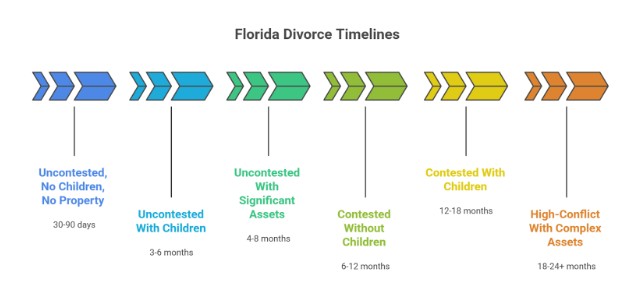
Florida divorces can take as little as 30 days for simple, uncontested cases or stretch over 18 months for tough contested ones. The details—kids, assets, disagreements—matter a lot.
| Scenario | Typical Timeline | Key Factors |
| Uncontested, No Children, No Property | 30-90 days | Both agree on everything; minimal paperwork after filing |
| Uncontested With Children | 3-6 months | Parenting plan required; sometimes a parenting course |
| Uncontested With Significant Assets | 4-8 months | Property division docs; maybe business valuations |
| Contested Without Children | 6-12 months | Discovery; multiple hearings; settlement talks |
| Contested With Children | 12-18 months | Custody evaluations, mediation, and drawn-out negotiations |
| High-Conflict With Complex Assets | 18-24+ months | Business valuations, forensic accounting, lots of experts, heavy litigation |
If you both agree and have simple finances, you might finish in under three months. But if you have fights about kids or big assets, expect a much longer haul.
A “Step-by-Step” Timeline (What Happens in Most Cases)
Florida divorces are split into two main paths. If you both agree, things move fast. If you don’t, the process gets a lot longer and messier.
Uncontested Path (The Fastest Clean Route)
The uncontested divorce timeline kicks off when you file your petition and pay the fee. You serve your spouse, and they have 20 days to answer.
Once you both sign a settlement agreement, you send it to the court. Florida still makes you wait 20 days from the filing date before you can finish things up.
After the wait, you show up for a final hearing. Judges often handle these cases quickly—sometimes in under 15 minutes. The judge checks your agreement and signs off.
Many uncontested divorces can wrap up in roughly 1 to 3 months, depending on how quickly service is completed and how soon the court can schedule the final hearing.
Contested Path (Where Timelines Expand)
The contested divorce timeline starts the same way, but quickly becomes complicated. After your spouse responds, you enter discovery. Both sides swap financial documents, ask questions, and maybe take depositions.
Discovery alone can eat up 3 to 6 months, depending on how much info you need and whether anyone’s stalling. Mediation often comes next—Florida courts usually require it before trial.
If mediation bombs, you wait for a trial date. Depending on your county, that could be 6 to 12 months out. Trials can last a day or stretch for several, depending on how messy things get.
Contested divorces usually take 6 months to 2 years. If you’re dealing with business valuations, custody battles, or hidden assets, expect the long end of that range.
If you’re weighing an uncontested vs. contested timeline, a quick call with Mulligan & Associates can clarify next steps and deadlines. Schedule an appointment.
The Biggest Timeline Accelerators (What Actually Speeds Things Up)
Getting your paperwork together early and presenting clear proposals can shave months off your divorce. These are the two areas you actually control.
“Paperwork and Proof” Accelerators
Gather your financial disclosure docs before you file. That means pay stubs, tax returns, bank statements, retirement accounts—the works.
When you hand in accurate affidavits right away, you avoid one of the most common slowdowns.
Essential documents to have ready:
- Tax returns (last three years)
- Six months of bank and credit card statements
- Property deeds and mortgage info
- Investment and retirement account statements
- Pay stubs or income proof
If you have assets to split, get professional appraisals before you start negotiating. When both sides agree on what things are worth, you clear a big hurdle.
Double-check every form before you file. Missing signatures, wrong notarization, or blank sections can get your paperwork kicked back. Then you’re stuck fixing mistakes and re-filing, which just drags things out.
“Prepared Negotiation” Accelerators
Walk into mediation with clear proposals, not fuzzy requests. Figure out what you want for property division, alimony, and parenting schedules before you get there.
When you put real numbers and terms on the table, your spouse can actually accept or push back on something concrete. It makes things move faster.
An uncontested divorce in Florida speeds up when both sides settle matters before filing. Draft a marital settlement agreement that covers every major issue.
Decide who keeps the house. Figure out how you’ll split retirement accounts. Don’t forget to discuss spousal support if it’s on the table.
Key items to negotiate upfront:
- Property division: Spell out who gets each asset and debt
- Spousal support: List the exact monthly amount and how long it lasts
- Parenting plan: Make a detailed schedule, including holidays
Jump on discovery requests and settlement offers as soon as you get them. If you drag your feet answering questions about your finances or reviewing terms, your case will take longer—sometimes a lot longer.
Set aside time each week to handle divorce-related tasks so you don’t fall behind.
The Most Common Delay Points (And How to Prevent Them)
Most Florida divorces get stuck on two big things: trouble getting papers served and court scheduling, or missing financial documents.
These hiccups can drag your case out for months, but you can avoid many of them with some good planning.
Service, Scheduling, and “Court Calendar” Realities
Florida makes you wait 20 days after you file before you can finish your divorce. It doesn’t matter if you both agree on everything.
Serving divorce papers can take forever if your spouse dodges the process server or lives far away. If you can’t find them, you’ll have to publish a notice in a newspaper, which just adds more time.
Court scheduling is another headache. Judges are swamped, and getting a hearing date might take weeks or even months, depending on your county.
Some counties move faster than others. It really depends on how many judges are available and how busy they are.
To prevent these delays:
- Hire a pro process server right after you file
- Keep your spouse’s contact info up-to-date
- Ask your lawyer how long the wait is in your county
- Request hearing dates as soon as you can
Disclosure and Document Gaps
Florida law says both spouses have to swap complete financial info through something called mandatory disclosure. If you’re missing bank statements, tax returns, or property values, your case just stops right there.
The court wants to see accurate information about your income, assets, debts, and expenses to make fair decisions.
If you turn in incomplete documents, the judge will send them back and make you redo them. That can eat up months on contested divorce timelines.
Common document problems include:
- Tax returns missing schedules or attachments
- Bank statements that don’t cover the right dates
- Business financial records that are incomplete
- No appraisals for real estate or retirement accounts
Start gathering your financial papers before you even file. Make copies of three years of tax returns, recent pay stubs, all your bank and investment statements, mortgage docs, and vehicle titles.
Keep everything in labeled folders so you can find what you need fast.
If You Have Minor Children, Add These Timeline Requirements
Florida requires parents going through a divorce take a parenting course before the court will finalize anything. This class adds about 4-6 weeks to your timeline, even if your divorce is uncontested and you get along.
Parenting Course (What It Is and Why It Matters for Finalization)
If you have minor children, the petitioner generally must complete the parenting course within 45 days after filing, and the other party within 45 days after service, unless excused for good cause.
Both you and your spouse need to take it, but you do it separately. Online classes are out there, so you can fit them around work and childcare.
The course covers how divorce affects kids, co-parenting tips, and ways to handle conflict. You can’t get your final divorce judgment until you turn in proof that you finished the course.
If you skip the parenting course, the judge won’t sign off on your divorce. This rule sticks whether your case is contested or uncontested.
Many courts will give you a temporary time-sharing arrangement before you finish the class. Still, your permanent parenting plan and final divorce order stay on hold until both parents hand in their certificates.
When to Speak with a Florida Divorce Attorney About Timeline Strategy
Start talking to a Florida divorce attorney the moment you even begin thinking about divorce. That early consultation gives you a sense of what’s coming and how you might want to prepare.
Key moments to seek legal advice include:
- Before you file any divorce paperwork
- When your spouse hands you divorce papers
- If you and your spouse can’t agree on custody, property, or support
- When you’re dealing with tricky asset division or own a business together
- If domestic violence or urgent issues are part of the picture
Meeting with a Florida divorce attorney who can explain timelines during a free consultation helps you sidestep a lot of headaches. The attorney looks over your situation and helps you map out a plan that actually fits your life.
An attorney can help you:
- Figure out if an uncontested divorce makes sense
- Get your documents filed right the first time
- Stay on top of court deadlines
- Move settlement talks along faster
- Spot issues that could slow everything down
When you talk through your circumstances with a lawyer, you get a much clearer idea of what your timeline might look like. Attorneys know how local courts operate and what usually causes cases to drag out.
Timing matters most when:
- You need the divorce wrapped up by a specific date
- Kids are in the middle, and you need custody sorted out
- Your finances are tangled or complicated
- Your spouse just isn’t cooperating
Getting legal advice early on gives you way more control. You’ll be able to make smarter choices, instead of scrambling when surprises pop up.
Ready to move forward with a timeline-focused plan for your Florida divorce? Get guidance on filings, service, and disclosures—Contact us at Mulligan & Associates.
Frequently Asked Questions
What’s the typical divorce timeline in Florida?
An uncontested Florida divorce often takes about 1–3 months, largely based on how quickly service is completed and how soon the court can schedule the final hearing. Contested cases commonly take 6–12+ months, especially with children or complex finances.
What is the minimum time to get divorced in Florida?
Florida generally cannot enter a final divorce judgment until at least 20 days after the petition is filed. Even then, you still must complete service, required paperwork, and any local court requirements before a judge can sign the final judgment.
When does the divorce “clock” start in Florida—when you file or when you serve?
Different clocks start at different times. Filing impacts when a final judgment can be entered, while service starts major deadlines, such as the respondent’s 20-day window to file an Answer and the timeline for required financial disclosures.
How long does an uncontested divorce take in Florida?
If both spouses agree on property, support, and parenting terms (if applicable), an uncontested divorce often finishes in about 1–3 months. The main variables are service speed, correct paperwork, and how quickly the court can schedule a final hearing.
How long does a contested divorce take in Florida?
A contested divorce often takes 6–12+ months because the case may require mandatory disclosures, discovery, mediation, motion hearings, and sometimes a trial. Timelines extend when spouses dispute custody, hide or dispute finances, or when the court calendar is busy.
What causes the biggest delays in Florida divorce cases?
The most common delays are difficulty serving papers, incomplete or late financial disclosures, disputes over parenting plans or support, and waiting for hearing dates. You can shorten timelines by organizing documents early and responding quickly to requests.
Does having children make a Florida divorce take longer?
Often, yes. Cases involving minor children typically require additional steps, such as parenting-plan details and completing the required parenting course before final judgment. If parents disagree on schedules or decision-making, mediation and court involvement can add months.