
How Divorce Works in Hernando County Court. Step-by-Step Process, Costs, Timeline, and What to Expect
In Hernando County, a Florida divorce usually starts by filing a Petition for Dissolution of Marriage with the Clerk, paying the filing fee, and serving your spouse.
After a 20-day response period, most cases proceed through required forms, parenting courses (if children), possible mediation, and a final hearing at which the judge enters judgment.
There’s a step-by-step view of how a case moves through the system, what happens at mediation or hearings, common costs and delays, and when it might be wise to hire a divorce lawyer or family law attorney.
Key Takeaways
- Most delays come from service issues, missing paperwork, financial disclosure problems, or parenting plan disputes.
- Hernando County divorce filing fees are published by the Clerk, with additional costs for summons, service, copies, and mediation depending on your case.
- Many cases still require mediation attempts before a contested trial, especially in family matters.
What “Hernando County Divorce Court” Means. Which Court Handles Divorce, and Where Cases Are Filed
Divorce in Hernando County is handled through the Florida Circuit Court Family Division, with filing and case processing conducted by the Hernando County Clerk of the Circuit Court. Your case path depends on whether it is a simplified or regular dissolution, whether children are involved, and whether your spouse contests any issue.
Circuit Court Vs Clerk’s Office. What Each One Does
The Fifth Judicial Circuit handles hearings, temporary orders, trials, and final divorce decisions.
If you need a judge to decide child custody, alimony, or property division, you’ll appear before the Circuit Court judge in Brooksville. That judge issues binding rulings and enforces court orders.
The Hernando County Clerk of Court takes your divorce paperwork, stamps it, keeps the records, and collects the filing fees. You’ll file the petition, summons, and financial affidavits with the Clerk.
The Clerk files and records your documents, collects fees, and provides certified copies when needed. Hearing scheduling follows the court’s procedures, and the parties typically file and serve the required notices.
Mulligan & Associates can explain how divorce works in Hernando County and help you avoid filing mistakes that can delay your case. Schedule an appointment today.
Your First Fork In The Road. Simplified Vs Regular Divorce In Hernando County

The main early decision is whether you qualify for simplified dissolution or need a regular divorce.
Simplified cases require agreement on key terms and usually avoid the contested pathway.
Regular divorce is the default when issues are disputed, children are involved, or the situation is more complex.
Quick Eligibility Checklist
- You both must want a simplified divorce and sign the papers.
- No minor kids together and no pregnancy by either spouse.
- You have to waive alimony and agree on how to split assets and debts.
- Both of you must have lived in Florida for at least six months before filing. File in Hernando County if you or your spouse lives there.
- No complicated property issues like business ownership, real estate fights, or big retirement accounts that need valuing.
- You must admit the marriage is irretrievably broken (no-fault) and sign under oath that your statements are true.
If you check all those boxes, a simplified divorce uses fewer forms and can be faster. Still, both spouses typically must attend the final hearing together to confirm eligibility and agreement.
If not—if you have kids, disagree about custody, argue over property, or want support—you’ll use the regular divorce process.
That one covers child custody, co-parenting plans, property division, and formal hearings.
Step By Step. How A Hernando County Divorce Actually Moves Through The System
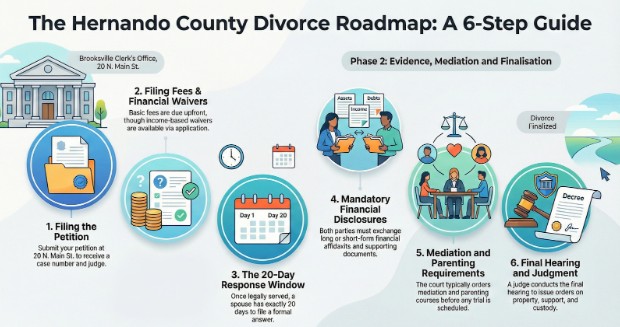
The Hernando County divorce process typically follows a predictable sequence. file, pay the fee, serve your spouse, wait for the response window, complete required forms, exchange financial information, address parenting requirements if applicable, attempt resolution (often including mediation), then schedule a final hearing for the judge to enter the final judgment.
Step 1. File Your Petition And Open The Case
You start by filing a Petition for Dissolution of Marriage with the Hernando County Clerk of Circuit Court, which opens the case in the circuit court family division.
You can file in person at 20 N. Main St., Room 165, Brooksville, or you may e-file through the Florida Courts E-Filing Portal as a self-represented litigant, though e-filing is not required for self-represented parties.
Fill out local forms and the statewide petition; sign under oath. If you want a simplified or uncontested divorce, include a marital settlement agreement to expedite the process.
The clerk assigns a number to your case and a judge. Keep a stamped copy as proof of case opening. This filing initiates the official timeline for all subsequent steps.
Step 2. Pay Filing Fees And Understand Add-On Costs
You’ll pay the basic filing fee up front; fees change, so double-check with the clerk. If you can’t pay, ask for a fee waiver (you’ll need an application and proof of income).
Plan for extra costs—process server, copies, certified records, maybe e-filing fees. You might pay for process server costs, mediator fees, and records (medical, tax, property).
Temporary hearings typically increase costs due to attorney time, document preparation, and service or copying expenses. Filing the motion itself is typically part of the existing case, but costs vary depending on what your case requires.
Step 3. Serve Your Spouse, Then Track The 20-Day Response Clock
After you file, you have to legally serve your spouse with the petition and a summons. Serve your spouse through the sheriff or a certified process server.
If your spouse agrees, they can accept service or waive formal service using the proper Florida forms. The sheriff or process server completes a return of service or proof of service, which is filed in the case to show that service was completed.
Once served, your spouse gets 20 days to file an Answer if they’re served in Florida. If they don’t respond, you can ask for a default.
If they answer, the case moves to scheduling, discovery, and temporary motions. Keep copies of service docs and watch the 20-day deadline.
Step 4. Complete Required Disclosures And Paperwork
In most Florida divorces, mandatory disclosure requires each party to provide specific financial documents to the other party within 45 days of service of the petition.
Simplified dissolution is generally exempt, and a narrow exemption can apply in limited situations.
File a Financial Affidavit using the short form if your gross annual income is under $50,000, and the long form if $50,000 or more, unless a specific exception applies.
In contested cases, formal discovery tools are used. interrogatories, document requests, subpoenas, and depositions. may be used to verify finances and case facts.
File your Financial Affidavit with the court, serve the required financial documents on the other party, then file a Certificate of Compliance with Mandatory Disclosure confirming what you provided.
If you miss deadlines, the court could impose sanctions or exclude evidence, so keep an eye on local rules.
Step 5. Parenting Requirements When Children Are Involved
If you have minor children, Florida requires a parenting plan and a time-sharing schedule. If you have minor children, both parents are generally required to complete the parenting course before the court enters a Final Judgment, unless a limited exception applies.
You can ask for temporary custody and support orders early by filing verified motions.
The court looks at the child’s best interest, school schedules, and safety. Gather school records, health records, and any incident reports.
If there’s domestic violence, seek immediate protective orders and let the court know—those issues affect timelines and orders.
Step 6. Mediation And Settlement Attempts
Hernando County pushes for mediation in parenting and financial disputes. The court often orders it before trial, and you’ll probably split the mediator fee unless the judge orders otherwise. Mediation can resolve time-sharing, alimony, property, and support without a trial.
Bring a settlement package: proposals, property lists, valuation docs, and a parenting plan.
If you settle in mediation, the written agreement is generally enforceable once signed and is typically submitted to the court for approval and incorporation into the Final Judgment.
Step 7. Final Hearing And Final Judgment
If you can’t settle, the court sets a final hearing or trial where you present evidence—witnesses, depositions, documents, valuations. Bring organized exhibits and follow the judge’s rules. Trials happen before a judge in the family division.
After hearing all the evidence, the judge issues a Final Judgment of Dissolution of Marriage. That judgment covers property, alimony, child support, time-sharing, and any permanent orders.
The timeline from filing to final judgment varies widely; uncontested cases might close in a few months, but contested cases with discovery and trial can drag out for a year or more.
If you are stuck on service, disclosures, or parenting requirements, Mulligan & Associates can map the fastest path forward in Hernando County. Contact us now.
Documents And Forms. What You Usually Need In Hernando County Divorces

You’ll need specific paperwork to start and move a divorce case in Hernando County. Expect to round up identity documents, financial records, and family-related forms that affect custody, support, and property division.
Core Document Checklist
- Petition for Dissolution of Marriage: your initial filing to open the case. Include names, marriage date, grounds, and what you’re asking for.
- Summons and Notice of Social Security Number: serve these to your spouse to notify them of the divorce.
- Family Law Financial Affidavit: file this if you want alimony, child support, or asset division. List your income, expenses, debts, and assets.
- Child Support Guidelines Worksheet: needed if you’ve got kids. Use it to calculate possible child support.
- Marital Settlement Agreement or Proposed Parenting Plan: Use these if you and your spouse agree on property, custody, support, or spousal support. A signed agreement speeds things up.
- Property records and appraisals: deeds, titles, appraisals, and statements for real estate, vehicles, and large assets support equitable division.
- Bank statements, pay stubs, and tax returns (past 2–3 years) support your income claims for child support and alimony.
- Proof of service and forms specific to Hernando County: get local packets and printable forms from the Hernando County Clerk’s Family Law page to make sure you file everything right.
What It Costs. Filing Fees And Common Case Expenses In Hernando County
You’ll pay a set court filing fee plus extra costs. These often include service, mediation, and document prep.
If you can’t afford the fees, you might qualify for a waiver—but you’ll have to prove you really can’t pay.
Cost Drivers That Surprise People
Hernando County’s dissolution filing fee is $408.00, plus add-on costs for summons issuance, service of process, copies, and mediation, depending on your case. That number isn’t set in stone, so it’s smart to check the clerk’s current fee schedule before jumping in.
If you pay with a credit or debit card, there’s an extra service charge—expect about 3.5% tacked on.
Service of process (whether by a sheriff or a private process server) costs $40–$75 per person. Court-required items, such as mediation or parenting classes, can incur an additional $50–$300 fee.
Attorney fees? Those are all over the map. Uncontested cases might be affordable, but if things get messy—with discovery and hearings—costs can climb fast.
If money’s tight, you can file an Application for Determination of Civil Indigent Status with the clerk. That allows you to request a waiver or an installment plan.
The Clerk and the Fifth Judicial Circuit Self-Help resources can point you to the correct forms and procedural checklists, but they cannot give legal advice about what you should file or ask for.
For up-to-date fee info and forms, check the Hernando County Clerk of Court fee schedule and family court resources online. It’s always changing, so don’t just guess.
What To Expect At Mediation And Hearings In Hernando County.
Most family cases start with mediation. If you can’t settle everything there, you’ll move on to hearings for any leftover issues.
Bring your documents, know what you want, and have important dates handy. That way, you can actually move negotiations—or a judge’s decision—toward a fair divorce decree.
Hearing Readiness Checklist
- Documents: Bring financial affidavits, pay stubs (60–90 days), tax returns (last 3 years), bank statements, mortgage or lease papers, insurance policies, and any custody records. Originals and a copy for the mediator, opposing counsel, and the court—don’t forget.
- Summary sheets: Make a one-page summary of income/expenses, plus a timeline of big events (like your separation date or school changes). Label exhibits and staple them in order.
- Child-related proof: Gather up school records, visitation logs, medical bills, and daycare receipts. Have a proposed parenting plan ready, with holidays and summer mapped out.
- Negotiation plan: Jot down three realistic priorities and at least one thing you could give up. If you want a collaborative divorce, please let us know and bring any signed participation agreements.
- Behavior and attire: Dress conservatively and remain calm. Silence your phone and skip the snarky comments about your ex.
- Court rules and filings: Double-check the mediation date, any required pre-mediation statement, and your hearing docket number with the Hernando County court clerk. Bring filed pleadings and your proposed divorce decree if you’ve got one.
- Logistics: Know where the mediator’s office is, where to park, and how long it might take. Arrive 20 minutes early with your ID and payment for mediation fees, if required.
- If mediation fails: Be ready to tell the judge what’s still unresolved. Bring concise exhibits and numbered proposed orders so the court can actually make clear rulings.
Common Mistakes That Delay Hernando County Divorces And How To Avoid Them
People miss forms, pay the wrong fees, or serve papers late—and those mistakes cause most delays.
Double-checking forms, paying the right amount, and following local rules can save you weeks or even months of headaches.
The “Avoid Delay” Checklist
- File the correct initial forms. Grab the Family Law forms from the Hernando County Clerk’s office or the Fifth Judicial Circuit self-help center. If you submit the wrong petition or leave fields blank, the clerk will return it to you.
- Pay the exact court fee. Hernando County’s dissolution filing fee is $408.00, but total out-of-pocket costs vary once you add service fees, copies, and mediation or parenting course fees. It’s smart to double-check with the Clerk before you pay—nobody wants their filing rejected over a few bucks.
- Serve papers promptly and properly. Hand-deliver papers to a sheriff or a certified process server, and ensure you obtain a signed proof of service. If you serve informally or drag your feet, you’ll just end up with delays.
- Provide accurate financial disclosures. Fill out the financial affidavits and attach what’s needed—pay stubs, tax returns, the usual suspects. Leaving this incomplete just means more motions and another hearing you didn’t ask for.
- Follow local rules and deadlines. Check the local rule checklists. Hit your mediation, parenting class, and disclosure deadlines, or you’ll probably face a continuance.
When you want clarity on timeline, costs, and next steps, work with Mulligan & Associates to protect your goals in Hernando County court. Schedule an appointment.
Frequently Asked Questions
How do I file for divorce in Hernando County, Florida?
To file for divorce in Hernando County, you submit a Petition for Dissolution of Marriage with the Hernando County Clerk of Circuit Court, pay the filing fee, and obtain a summons for service. After the case is opened, you must properly serve your spouse to start the response timeline.
How much does it cost to file for divorce in Hernando County?
Hernando County’s dissolution filing fee is $408.00, but total costs can rise with summons issuance, service of process, certified copies, and mediation. If you cannot afford the filing fee, you may request indigent status and ask about a waiver or payment options.
How long does a divorce take in Hernando County court?
An uncontested divorce can often be finalized in a few months if service is completed quickly and paperwork is correct. A contested divorce can take much longer. especially when financial disclosure, parenting issues, discovery disputes, or trial scheduling create delays in the case.
What happens after my spouse is served in Hernando County?
After service, your spouse typically has 20 days to file an Answer or other response. If they do not respond, you can request a default and move the case toward finalization. If they respond, the case proceeds through required disclosures, possible mediation, and hearings as needed.
Do parents have to take a parenting course in a Hernando County divorce?
If minor children are involved, both parents are generally required to complete the Florida parenting course before the court enters a Final Judgment, unless a limited exception applies. The course is separate from custody decisions, but failing to complete it can delay your final hearing.
Is mediation required in Hernando County divorce cases?
Many Hernando County divorce cases are referred to mediation, especially when parenting or financial issues remain disputed. Mediation can help resolve time-sharing, support, and property division without a trial. If mediation fails, the court will set further hearings and may schedule a trial.
What documents should I bring to mediation or a final hearing?
Bring your financial affidavit, recent pay stubs, tax returns, bank statements, and records for major assets and debts. If children are involved, bring a proposed parenting schedule and records of child-related expenses. Organized documents reduce delays and improve the quality of settlement discussions.