
Domestic Partnership vs. Marriage in Florida: What’s the Difference?

Reviewed by Christopher S. Mulligan, Esq., who has practiced family law in Brooksville since 2007 and advises Hernando County couples on cohabitation agreements, property division, and parentage.
A domestic partnership in Florida is a local registration that some counties and cities offer to unmarried couples, while marriage is a state-licensed status recognized in all 50 states and by federal agencies.
Florida has no statewide partnership status equivalent to marriage, so a registry certificate carries only the benefits its local ordinance grants.
Christopher S. Mulligan, a family law attorney at Mulligan & Associates, P.A. in Brooksville, Florida, helps couples compare the two.
Key Takeaways
- At least eight Florida counties, including Hillsborough, Pinellas, and Palm Beach, run domestic partnership registries, but no Florida statute creates a statewide partnership status.
- Fla. Stat. §741.211 voids common-law marriages entered into after January 1, 1968, so living together never creates a marriage.
- A surviving spouse takes an intestate share under Fla. Stat. §732.102, while a domestic partner has no intestate share.
- The IRS bars registered domestic partners from filing jointly on a federal return.
Unsure whether a registry certificate covers enough? Mulligan & Associates reviews registration, property ownership, and the documents each couple’s goals call for. Schedule a consultation.
How Do Marriage and Domestic Partnership Compare in Florida?
Marriage gives Florida couples a uniform set of rights under state and federal law. A domestic partnership provides what the local ordinance offers, plus whatever a hospital, employer, or other institution agrees to recognize.
| Issue | Marriage | Domestic Partnership |
| Where it is recognized | All 50 states and federal agencies | Under the local ordinance, plus institutions that choose to honor it |
| Federal tax filing | Married filing jointly or separately | Each partner files as single or head of household |
| Inheritance without a will | Spouse takes an intestate share by statute | No intestate share; assets pass only by title, trust, or valid designation |
| Medical decisions without a surrogate document | Spouse ranks second as statutory proxy | Partner may qualify as a close-friend proxy only if no higher-priority person can act |
| Social Security spousal and survivor benefits | Available to eligible spouses | Not available |
| Green card sponsorship | A citizen or permanent resident can petition for a spouse | Not available |
| FMLA leave to care for a partner | Covers care for a spouse | Does not cover a domestic partner |
| Ending the relationship | Dissolution in circuit court, with property division and possible alimony | Termination filed with the local registry |
Does Florida Recognize Domestic Partnerships?
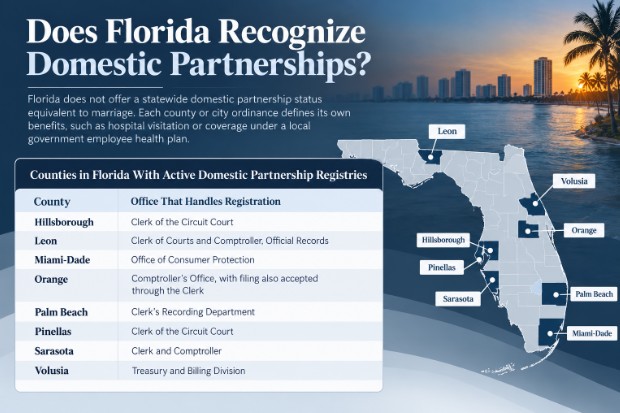
Florida does not offer a statewide domestic partnership status equivalent to marriage. Each county or city ordinance defines its own benefits, such as hospital visitation or coverage under a local government employee health plan.
Official county pages confirm active registries in these eight counties:
| County | Office That Handles Registration |
| Hillsborough | Clerk of the Circuit Court |
| Leon | Clerk of Courts and Comptroller, Official Records |
| Miami-Dade | Office of Consumer Protection |
| Orange | Comptroller’s Office, with filing also accepted through the Clerk |
| Palm Beach | Clerk’s Recording Department |
| Pinellas | Clerk of the Circuit Court |
| Sarasota | Clerk and Comptroller |
| Volusia | Treasury and Billing Division |
Some cities run their own registries, including Orlando, St. Petersburg, Sarasota, and North Port. Tampa no longer accepts new city registrations.
Older Tampa certificates remain valid but don’t appear in the Hillsborough County registry, and they cannot be transferred, so Tampa couples who want a countywide listing must register with the county separately.
What Rights Does Marriage Give That a Domestic Partnership Does Not?
Spouses automatically receive the protections below; domestic partners must build most of them through documents, title, and contracts.
Inheritance and Property
Florida’s intestacy statute, Fla. Stat. §732.102, gives a surviving spouse a share of an estate when there is no will, and Fla. Stat. §732.401 adds homestead protections. A domestic partner has no intestate share.
A partner still keeps property in that partner’s own name, takes a co-owned home when the deed includes survivorship rights, and receives assets left by trust, will, or valid beneficiary designation.
After a breakup, property division turns on title, contributions, and any written agreement.
Medical Decisions
A health care surrogate is someone the patient names in writing under Fla. Stat. §765.202, signed before two adult witnesses, one of whom cannot be a spouse or blood relative.
A surrogate’s authority usually begins when the patient lacks capacity, unless the designation makes it effective immediately.
A health care proxy acts only when the patient has no available surrogate. Fla. Stat. §765.401 ranks possible proxies in order: a court-appointed guardian with authority over medical consent, the spouse, an adult child, a parent, an adult sibling, a qualifying adult relative, a close friend, and, last, a licensed clinical social worker.
A person lower on the list serves only when nobody higher can be reached, is willing, or is able to act.
Fla. Stat. §765.101 treats a close friend as an adult who has shown genuine involvement in the patient’s welfare and who provides the facility or physician with a sworn affidavit.
Taxes and Federal Benefits
The IRS guidance on registered domestic partners confirms they cannot file as married. The Department of Labor excludes domestic partners from the FMLA definition of spouse.
Children and Legal Parentage
Florida generally presumes that a married mother’s spouse is a parent of a child born during the marriage, although limited cases can challenge that presumption.
When a married couple conceives through donated sperm, donated eggs, or preembryos, or in vitro fertilization, and both spouses consent in writing, Fla. Stat. §742.11 makes both spouses the child’s legal parents; gestational surrogacy follows separate rules.
Unmarried parents usually establish parentage through a voluntary acknowledgment of paternity, a paternity action under Chapter 742, or adoption and legal parentage proceedings.
How Do Couples Register a Domestic Partnership in Florida?
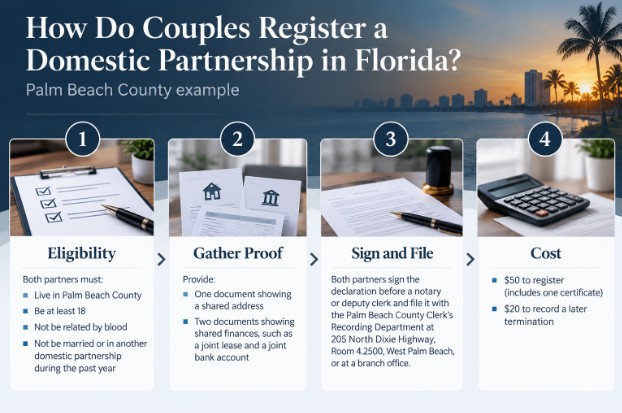
Each registry sets its own rules. Palm Beach County’s registry shows what a typical application involves:
- Eligibility: both partners live in Palm Beach County, are at least 18, are not related by blood, and have not been married or in another domestic partnership during the past year.
- Proof: one document showing a shared address and two showing shared finances, such as a joint lease and a joint bank account.
- Filing: both partners sign the declaration before a notary or deputy clerk and file it with the Palm Beach County Clerk’s Recording Department at 205 North Dixie Highway, Room 4.2500, West Palm Beach, or at a branch office.
- Cost: $50 to register (includes one certificate) and $20 to record a later termination.
Hillsborough County also charges $50 and requires a notarized, witnessed affidavit.
How Do Couples Get Married in Florida?
Couples apply for a license at a county clerk’s office and hold the ceremony within 60 days of issuance. Same-sex couples have been able to marry in Florida since January 6, 2015, after Brenner v. Scott, and Obergefell v. Hodges made that right nationwide on June 26, 2015.
- Application: both applicants complete the application, visit the clerk’s office, and show proof of age and identity, such as a driver’s license or passport.
- Waiting period: under Fla. Stat. §741.04, Florida residents wait 3 days unless both complete a premarital preparation course, and nonresidents have no wait.
- Fee in Hernando County: $86, or $61 with course completion certificates, according to the Hernando County Clerk.
How Can Unmarried Couples Protect Each Other Without a Registry?
Most Florida counties, including Hernando County, have no county registry, so couples there rely on private legal documents.
What a Cohabitation Agreement Should Cover
A cohabitation agreement is a written contract that sets the financial rules for an unmarried couple during the relationship and after a breakup.
Florida courts generally enforce them under ordinary contract principles. Useful terms include:
- ownership of property bought together
- how rent or mortgage, utilities, and groceries are split
- responsibility for debts in either partner’s name
- who keeps pets
- what happens to the shared home if the couple separates
Title and Beneficiary Designations
Partners can hold a home as joint tenants with right of survivorship, add payable-on-death or transfer-on-death designations to accounts, and name each other on life insurance and retirement accounts.
A valid designation usually pays the named beneficiary regardless of the will, subject to the plan’s own rules, so partners should review designations after any major change.
Which Documents Do Unmarried Couples Need?
Each document addresses one concern; none covers everything, and individual circumstances determine which ones a couple needs.
| Concern | Document | What It Does Not Do |
| Medical decisions during incapacity | Health care surrogate designation | Does not cover finances |
| Finances during incapacity | Durable power of attorney | Ends at death |
| Who inherits | Will or revocable trust | A will passes through probate; a trust works only for assets placed in it |
| Jointly owned home | Deed with right of survivorship | Does not settle unequal contributions after a breakup |
| Accounts and insurance | Beneficiary or payable-on-death designation | Stays outdated until changed |
| Money and property in a breakup | Cohabitation agreement | Does not bind a court on child support or time-sharing |
| End-of-life wishes | Living will | Does not name a decision-maker by itself |
Hypothetical example: Couple A registers in Miami-Dade County and signs nothing else.
A hospital outside the county may not be bound by the Miami-Dade ordinance, and without a surrogate designation, the other partner could rank behind available relatives as proxy.
Couple B never registers but properly signs surrogate designations, wills, and a survivorship deed. Those documents generally give clearer protection than a local registration alone, though each document’s validity and scope still matter.
Registration and private documents each have trade-offs. Mulligan & Associates explains how each fits a couple’s property, health care, and inheritance goals. Contact the firm.
Frequently Asked Questions
What legal rights do married couples have in Florida that domestic partners don’t?
Spouses take an intestate share without a will, file joint federal tax returns, can qualify for Social Security spousal and survivor benefits, seek alimony and equitable distribution in divorce, and rank second as health care proxy. Domestic partners need documents for most of these protections.
Can domestic partners make healthcare decisions in Florida?
Yes. A partner can name a health care surrogate under Fla. Stat. §765.202 to make decisions when the patient cannot. Without that document, a partner may serve as a close-friend proxy under Fla. Stat. §765.401 only when no higher-priority person can act.
Is a domestic partnership in Florida the same as a common-law marriage?
No. A domestic partnership is a local registration with limited benefits. A common-law marriage is a full marriage formed without a license, which Florida stopped allowing after January 1, 1968, under Fla. Stat. §741.211, although Florida recognizes one validly formed in another state.
Should a couple choose a domestic partnership or marriage in Florida?
The choice depends on the protections the couple needs. Marriage offers inheritance, tax, Social Security, and divorce rights nationwide. A domestic partnership offers local benefits such as hospital visitation and an easier exit, but leaves gaps that contracts and estate documents must fill.
Can a domestic partner inherit without a will in Florida?
Not through intestacy. Fla. Stat. §732.102 and §732.103 give a domestic partner no share. A partner can still receive assets through a trust, a survivorship deed, a payable-on-death account, a life insurance designation, or a will executed before death.
Can domestic partners file taxes jointly?
No. The IRS does not treat registered domestic partners as married, so they cannot file a federal return as married filing jointly or married filing separately. Each partner files as single or, when eligible, head of household. Florida has no personal income tax.
Do domestic partners get alimony in Florida?
No. Florida alimony under Fla. Stat. §61.08 and §61.09 is available only between spouses. Former partners can recover support or property only through a valid written agreement or ordinary property and contract claims, so terms negotiated before a breakup carry the most weight.
How is a domestic partnership ended in Florida?
A Florida domestic partnership ends at the local registry, not in family court. In Miami-Dade County, either partner files a notarized termination declaration, effective 30 days after the certificate issues. Orlando requires a notarized termination affidavit. Neither registry divides property or awards support.
Does a domestic partner have rights to a partner’s child in Florida?
Registration alone creates no parental rights. Florida parentage comes through birth to a married parent, assisted reproduction with written spousal consent under Fla. Stat. §742.11, acknowledgment or court action under Chapter 742, or adoption. Partners outside those routes generally face limits seeking time-sharing.
Can a domestic partner get health insurance through a partner’s employer in Florida?
Sometimes. Coverage depends on the employer’s plan, since Florida law does not require private employers to offer domestic partner benefits. Employers that extend coverage often ask for a registry certificate or proof of shared residence, and the IRS can tax that coverage as income.
What can couples do if their Florida county has no domestic partnership registry?
Unregistered couples can build similar protections with private documents. A cohabitation agreement sets property and expense terms, wills or trusts pass assets, a health care surrogate designation covers medical decisions, and a durable power of attorney covers finances. Beneficiary designations move accounts without probate.
Does registering a domestic partnership replace a will or power of attorney?
No. A registry certificate grants only the local benefits in its ordinance. It does not pass property at death, authorize anyone to manage finances, or name a health care surrogate, so registered partners still need a will, durable power of attorney, and surrogate designation.
Bottom Line
Marriage is the only Florida status that automatically provides inheritance, tax, federal benefit, and divorce protections. A domestic partnership exists only where a county or city ordinance creates one, and its benefits come from that ordinance and from institutions that choose to honor it.
Couples living together without marrying, including those in Hernando County, protect each other through cohabitation agreements, wills, surrogate designations, title choices, and beneficiary forms.
Planning before an illness or breakup can prevent later disputes. Mulligan & Associates helps Brooksville couples choose and prepare the documents. Book a consultation.

About the Author
Christopher S. Mulligan
Florida Bar Member in Good Standing since November 9, 2007 (Bar No. 47524) · J.D., The George Washington University Law School, 2006
Christopher S. Mulligan is a third-generation Florida attorney and founder of Mulligan & Associates in Brooksville, Florida. He drafted provisions of the 2005 Violence Against Women Act reauthorization and serves as a Guardian ad Litem and Attorney ad Litem for children in foster care. He has practiced family law in Hernando County since 2007 and represents families in divorce, custody, support, adoption, dependency, and injunction matters throughout the Fifth Judicial Circuit.