
Stalking Injunctions in Florida: How to File One or Respond to One
Reviewed by Christopher S. Mulligan, Esq., who has handled family law matters in Brooksville since 2007 and appears for both petitioners and respondents at Hernando County injunction hearings.
A stalking injunction in Florida is a civil court order that bars a person from stalking or cyberstalking the petitioner, and it requires no family, household, or dating relationship between the two.
The petitioner must show at least two separate incidents of stalking, and a judge can issue a temporary order the day the petition is filed.
Mulligan & Associates, P.A., a Brooksville, Florida family law firm, handles stalking injunctions for both sides.
Key Takeaways
- Fla. Stat. §784.0485 lets any stalking victim, or a parent of a minor living at home, file without a filing fee and without an attorney.
- Florida appellate courts require proof of at least two separate incidents of stalking before a final injunction can be entered.
- A temporary stalking injunction lasts no more than 15 days, and the full hearing must be set before it expires.
- A respondent under a final stalking injunction that is in force cannot possess firearms or ammunition under Fla. Stat. §790.233, apart from a narrow exception for certified officers on official duty.
Stalking cases reach a hearing within about two weeks. Mulligan & Associates helps petitioners build their case, and respondents prepare their defense. Contact the firm.
What Is a Stalking Injunction in Florida?
A stalking injunction is a protective order under Fla. Stat. §784.0485 that covers stalking and cyberstalking by anyone, including a neighbor, coworker, former friend, or stranger.
Domestic violence and dating violence injunctions depend on the relationship between the parties, but a stalking injunction turns only on the respondent’s conduct.
Key filing rules include:
- Who can file: the victim, or a parent or legal guardian on behalf of a minor child who lives at home.
- Cost: the clerk cannot charge a filing fee, and no bond is required.
- Lawyers: neither side is required to have one.
- Where to file: the circuit where the petitioner lives or is temporarily staying, where the respondent lives, or where the stalking happened.
- Other cases: a petition can be filed while another case between the parties is pending, but the petition must disclose it.
The court cannot enter mutual injunctions. If both people claim stalking, each must file and prove a separate petition.
What Counts as Stalking and Cyberstalking Under Florida Law?
Stalking under Fla. Stat. §784.048 is willfully, maliciously, and repeatedly following, harassing, or cyberstalking another person. Each term has a specific statutory meaning.
| Term | What Florida Law Requires |
| Harass | A course of conduct aimed at one specific person that causes substantial emotional distress and serves no legitimate purpose |
| Course of conduct | A series of acts over any period of time, however short, showing a continuing purpose |
| Cyberstalk | Repeated electronic messages, images, or language aimed at a specific person, or accessing that person’s online accounts or internet-connected home systems without permission |
| Credible threat | A threat that makes the target reasonably fear for personal or family safety, made by someone who appears able to carry it out |
| Excluded conduct | Constitutionally protected activity, such as picketing or organized protest |
The Two-Incident Requirement
Florida appellate courts require a petitioner to prove at least two separate incidents of stalking. In David v. Schack, 192 So. 3d 625 (Fla. 4th DCA 2016), the Fourth District held that each incident must be proven by competent, substantial evidence and judged under a reasonable person standard, and it reversed an injunction supported by only one incident.
In Hegedus v. Willemin, No. 5D19-958 (Fla. 5th DCA 2019), the Fifth District reversed because one of two claimed incidents, driving into a parking lot during a public event, did not qualify.
Courts still view the incidents together as a course of conduct, so context and any legitimate purpose for the contact matter.
How Courts Separate Stalking From Legitimate Contact
Hypothetical example: A former business partner sends three emails over a month about an unpaid invoice, which likely serve a legitimate purpose.
If the same person later posts the other partner’s home address online and keeps texting after being told to stop, those later acts may qualify as harassment, because they serve no legitimate purpose and could cause a reasonable person substantial emotional distress.
Courts judge that distress objectively, as the Second District explained in Goudy v. Duquette, 112 So. 3d 716 (Fla. 2d DCA 2013).
How Does Someone File for a Stalking Injunction in Florida?
A petitioner files a sworn petition with the Clerk of the Circuit Court that describes each stalking incident with specific facts, including dates, places, and what happened.
In Hernando County, petitions go to the Clerk at the Brooksville courthouse, where Hernando County family court hears injunction cases, and the clerk’s office provides forms and helps with filing.
Evidence works best when it supports each legal element: repetition, no legitimate purpose, and distress a reasonable person would feel. A strong petition usually includes:
- Dated incidents. Each incident listed separately, with what the respondent did and how the petitioner learned of it.
- Evidence. Screenshots, call logs, social media messages, photos, video, and police report numbers.
- Respondent details. Last known address, employer, and a physical description, which help the sheriff complete service.
- Related cases. Any pending case or prior injunction between the parties.
- Safety concerns. Threats, weapons, harm to pets, or property damage, which the court form asks about directly.
A sample chronology entry might read: “March 3, 9:40 p.m.: respondent sent four texts after being asked on March 1 to stop; screenshots attached as Exhibit 2.” A petitioner who needs to keep the home address private can provide it in a separate confidential filing.
What Happens Between the Temporary and Final Injunction?
A Florida stalking case moves through four stages, usually within about two weeks, much like the first 72 hours after filing in other injunction cases. The respondent gets a full hearing before the court enters any final injunction.
| Stage | Timing | What Happens |
| Temporary injunction review | Day of filing, without the respondent present | The judge grants a temporary order if the petition shows stalking exists; a denial must be in writing with the reasons |
| Service | As soon as possible after issuance | The sheriff personally serves the respondent with the petition, notice of hearing, and any temporary order |
| Full hearing | Before the temporary order expires, within 15 days | Both sides testify, present evidence, and call witnesses; continuances for good cause extend the temporary order |
| Final injunction | Entered after the hearing | Lasts for the period the order states, either a fixed term or until further court order; either party can ask to modify or dissolve it |
When a judge denies a temporary order because no immediate danger appears, the court must still set a full hearing as soon as possible.
Under Fla. Fam. L. R. P. 12.610, final relief is granted for a fixed period or until further order, and the victim can ask to extend it, so the order itself controls how long it lasts. A final injunction can also require counseling or treatment at the respondent’s expense.
What Should a Respondent Do After Being Served With a Stalking Injunction?
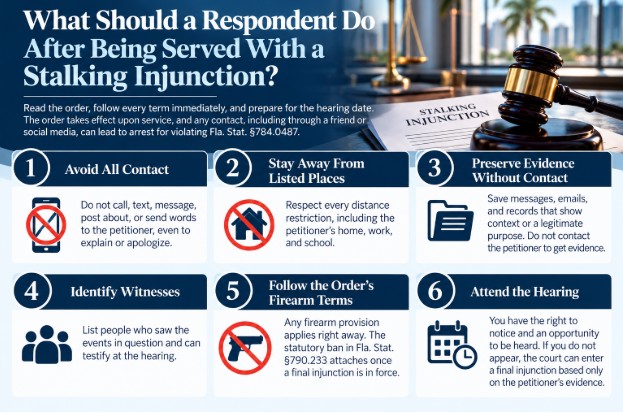
A respondent who has been served should read the order actually served, follow every term immediately, and prepare for the hearing date printed on the notice.
The order takes effect upon service, and any contact, including through a friend or social media, can lead to arrest for violating Fla. Stat. §784.0487.
- Avoid all contact. Do not call, text, message, post about, or send words to the petitioner, even to explain or apologize.
- Stay away from listed places. Respect every distance restriction, including the petitioner’s home, work, and school.
- Preserve evidence without contact. Save messages, emails, and records that show context or a legitimate purpose. Preserving evidence never requires contacting the petitioner or asking anyone to relay a message.
- Identify witnesses. List people who saw the events in question and can testify at the hearing.
- Follow the order’s firearm terms. Any firearm provision in the served order applies right away. The statutory ban in Fla. Stat. §790.233 attaches once a final injunction is in force, with a narrow exception for certified officers carrying for their agency.
- Attend the hearing. The respondent has the right to notice and an opportunity to be heard, and the proceeding is recorded. A respondent who does not appear risks a final injunction based solely on the petitioner’s evidence.
How Is a Stalking Injunction Different From a Criminal Stalking Charge?
A stalking injunction is a civil order the victim seeks, while a stalking charge is a criminal case brought by the state attorney.
The two can proceed at the same time, and a court can enter an injunction even if no one is charged.
Under Fla. Stat. §784.048(2), stalking is a first-degree misdemeanor.
Aggravated stalking, a third-degree felony, requires the same willful, malicious, and repeated following, harassing, or cyberstalking plus one added element: a credible threat under subsection (3), knowing conduct after an injunction or other court order prohibiting it under subsection (4), or a victim under 16 under subsection (5). An injunction does not automatically make later contact aggravated stalking, because the state must prove every element.
When Should Someone Call a Brooksville Stalking Attorney?
The best time to call a Brooksville stalking attorney is before the full hearing, because the hearing is usually the main opportunity to present evidence before a final order enters.
Christopher S. Mulligan has practiced family law in Brooksville since 2007 and appears in Hernando County injunction hearings.
A consultation reviews whether the incidents meet the legal standard, which evidence to bring, and what the hearing will involve. A stalking injunction does not decide custody or property, but the same facts can come up in a pending divorce or parenting case.
| Preparation Step | Petitioner | Respondent |
| Before the hearing | Build a dated chronology of each incident | Read the served order and comply with every term |
| Evidence | Screenshots, call logs, police reports, witnesses | Records showing context, legitimate purpose, or inaccuracies |
| At the hearing | Show two qualifying incidents and objective distress | Test each incident against the legal definition |
| After the hearing | Track the order’s duration and seek extension if needed | Follow the final order and consider a later motion to modify |
A final stalking injunction stays public while it lasts. Mulligan & Associates prepares clients for the hearing that decides it. Schedule a consultation.
Frequently Asked Questions
Is a relationship required for a stalking injunction in Florida?
No. A Florida stalking injunction requires no family, household, romantic, or dating relationship. A petitioner can seek one against a neighbor, coworker, former friend, online acquaintance, or stranger, as long as the evidence shows at least two separate incidents of stalking.
How many incidents are needed for a stalking injunction in Florida?
At least two. Florida appellate courts require proof of two separate incidents of stalking, each established by competent, substantial evidence and judged under a reasonable person standard. A single confrontation, however upsetting, generally does not support a final stalking injunction under Fla. Stat. §784.0485.
Is cyberstalking covered by a Florida stalking injunction?
Yes. Florida’s stalking statute includes cyberstalking, which covers repeated electronic messages, images, or language aimed at a specific person, and unauthorized access to that person’s online accounts or connected home devices, when the conduct causes substantial emotional distress without a legitimate purpose.
How much does it cost to file a stalking injunction in Florida?
Nothing. Fla. Stat. §784.0485 bars the clerk from charging a filing fee for a stalking injunction petition, and the court cannot require a bond. The sheriff serves the respondent, and neither party must hire a lawyer, though many choose to.
How long does a stalking injunction last in Florida?
A temporary stalking injunction lasts no more than 15 days, or longer if the court continues the hearing. A final injunction lasts for a fixed period or until further court order, depending on its terms, and either party can move to modify or dissolve it.
Can a stalking injunction be filed for a child in Florida?
Yes. A parent or legal guardian can petition on behalf of a minor child who lives at home. Stalking a child under 16 is also aggravated stalking, a third-degree felony under Fla. Stat. §784.048(5), which a state attorney can prosecute separately.
What happens if the respondent does not show up to the hearing?
The judge can enter a final stalking injunction based on the petitioner’s evidence, as long as the respondent was properly served with the petition and notice of hearing. Respondents who cannot attend should ask the court for a continuance before the hearing date.
Does a stalking injunction go on a criminal record?
A stalking injunction is a civil order, not a criminal conviction. However, a final injunction is a public court record entered into a statewide verification system for law enforcement, so it can appear in some background searches and can affect firearm ownership.
Can a respondent get a stalking injunction dismissed in Florida?
A respondent can contest the petition at the full hearing and can later file a motion to dissolve or modify a final injunction. Common challenges include fewer than two qualifying incidents, a legitimate purpose for the contact, and protected activity such as lawful protest.
What happens if the respondent cannot be served before the hearing?
The court can continue the hearing for good cause, including time to complete service, and the temporary injunction stays in effect during the continuance. Fla. Stat. §784.0485 requires personal service of the petition, notice, and any temporary order before the full hearing.
Bottom Line
A Florida stalking injunction protects against stalking and cyberstalking by anyone, with no relationship required. Petitioners should document each incident with dates and evidence before filing.
Respondents should comply with the order as served and prepare for the full hearing with a Brooksville family law attorney, because a final order can remain in place for a fixed term or until the court issues further orders.
The full hearing is usually where each side makes its record. Mulligan & Associates represents petitioners and respondents in Hernando County. Book a consultation.

About the Author
Christopher S. Mulligan
Florida Bar Member in Good Standing since November 9, 2007 (Bar No. 47524) · J.D., The George Washington University Law School, 2006
Christopher S. Mulligan is a third-generation Florida attorney and founder of Mulligan & Associates in Brooksville, Florida. He drafted provisions of the 2005 Violence Against Women Act reauthorization and serves as a Guardian ad Litem and Attorney ad Litem for children in foster care. He has practiced family law in Hernando County since 2007 and represents families in divorce, custody, support, adoption, dependency, and injunction matters throughout the Fifth Judicial Circuit.