
Florida Injunction Timeline: What Happens in the First 72 Hours After Filing
A petitioner who files for an injunction for protection in Hernando County can receive a temporary injunction from a circuit court judge within hours of filing — often on the same day.
Florida Statutes Section 741.30 requires the court to review every domestic violence injunction petition “as soon as possible,” and Hernando County judges in the Fifth Judicial Circuit routinely rule on temporary injunctions within the first 24 hours.
Mulligan & Associates, a Brooksville, Florida family law firm, represents petitioners and respondents through every stage of the injunction process in Hernando County.
The first 72 hours after filing determine whether a temporary injunction is granted, how quickly law enforcement serves the respondent, and what immediate protections take effect.
Key Takeaways
- Florida Statutes Section 741.30 authorizes judges to issue a temporary domestic violence injunction without a hearing, often within 24 hours of the petitioner’s filing.
- The Hernando County Sheriff’s Office serves the temporary injunction on the respondent, and all terms of the injunction become enforceable the moment the respondent is served.
- A full evidentiary hearing must occur within 15 days of the temporary injunction under Florida Statutes Section 741.30(5)(c), where both parties present testimony and evidence.
- Violating any term of a temporary injunction is a first-degree misdemeanor under Florida Statutes Section 741.31, punishable by up to 1 year in jail.
A protective injunction can change your safety within hours — contact Mulligan & Associates in Brooksville to file with experienced legal guidance today.
What Is an Injunction for Protection Under Florida Law?
An injunction for protection is a court order that prohibits a respondent from contacting, approaching, or threatening the petitioner.
Florida Statutes Section 741.30 governs domestic violence injunctions, which cover spouses, former spouses, co-parents, household members, and individuals related by blood or marriage.
Florida law recognizes four categories of injunctions for protection, each governed by a separate statute and triggered by a distinct type of threat or violence.
| Injunction Type | Governing Statute | Who Can File |
| Domestic Violence | Section 741.30 | Spouses, former spouses, co-parents, household members, persons related by blood or marriage |
| Repeat Violence | Section 784.046 | Any person who has experienced two or more incidents of violence by the same individual |
| Dating Violence | Section 784.046 | Individuals in a continuing, significant romantic relationship within the past 6 months |
| Sexual Violence | Section 784.046 | Victims of sexual battery or lewd acts, regardless of their relationship to the offender |
Each injunction type follows the same two-stage procedural structure in Hernando County family court: the petitioner files, a judge reviews for a temporary injunction, and the court schedules a full evidentiary hearing within 15 days.
How an Injunction Differs From a Criminal Charge
An injunction for protection is a civil court order, not a criminal prosecution. The petitioner files the injunction petition directly with the Hernando County Clerk of the Circuit Court — no arrest, no police report, and no state attorney involvement is required to initiate the process.
A criminal domestic violence case requires law enforcement arrest and state attorney prosecution under Florida Statutes Section 741.28, and the two proceedings operate on separate tracks.
What Happens in the First 72 Hours After Filing for an Injunction?
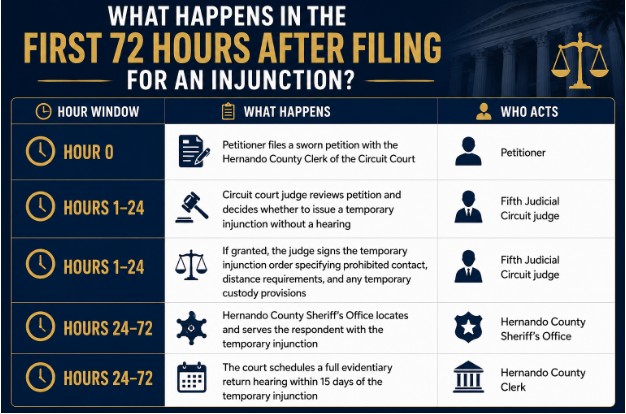
The first 72 hours after filing an injunction petition in Hernando County follow a compressed timeline that moves faster than any other family court proceeding.
The petitioner files the petition, a judge reviews the sworn allegations, and the Hernando County Sheriff’s Office serves the respondent — all within a window that can close in less than three days.
Mulligan & Associates prepares clients for each stage of the 72-hour window, so petitioners understand which protections take effect immediately and which obligations attach to the temporary order.
| Hour Window | What Happens | Who Acts |
| Hour 0 | Petitioner files a sworn petition with the Hernando County Clerk of the Circuit Court | Petitioner |
| Hours 1–24 | A circuit court judge reviews the petition and decides whether to issue a temporary injunction without a hearing | Fifth Judicial Circuit judge |
| Hours 1–24 | If granted, the judge signs the temporary injunction order specifying prohibited contact, distance requirements, and any temporary custody provisions | Fifth Judicial Circuit judge |
| Hours 24–72 | Hernando County Sheriff’s Office locates and serves the respondent with the temporary injunction | Hernando County Sheriff’s Office |
| Hours 24–72 | The court schedules a full evidentiary return hearing within 15 days of the temporary injunction | Hernando County Clerk |
Why the First 24 Hours Matter Most
Florida Statutes Section 741.30(5)(a) requires the court to review a domestic violence injunction petition “as soon as possible after the petition is filed.” Hernando County judges typically review petitions on the same business day the petitioner files.
A family law attorney in Brooksville who files the petition early in the morning can often obtain a signed temporary injunction by the end of that same court day, so the petitioner gains legal protection before the respondent learns about the filing.
What Happens If the Judge Denies the Temporary Injunction
A judge who finds insufficient allegations to support immediate danger may deny the temporary injunction but still schedule the full evidentiary hearing. The petitioner retains the right to present live testimony and evidence at the return hearing even when no temporary order is issued.
How Does a Hernando County Judge Decide Whether to Grant a Temporary Injunction?
A Hernando County circuit court judge evaluates the sworn petition without input from the respondent when deciding whether to issue a temporary injunction. Florida Statutes Section 741.30(5)(a) authorizes this ex parte review — meaning the respondent does not attend and does not receive advance notice — because domestic violence injunction petitions involve allegations of immediate danger.
The judge applies a specific legal standard: whether the petitioner’s sworn allegations demonstrate an immediate and present danger of domestic violence. The petition must describe specific acts of violence, threats, or conduct that place the petitioner in reasonable fear of imminent harm.
Factors Judges Evaluate in the Petition
Hernando County judges weigh the specificity and recency of the alleged conduct when reviewing injunction petitions. A petition that names specific dates, describes particular threatening statements, and identifies the location where violence occurred carries more weight than a petition with vague or generalized allegations.
Florida courts also consider prior domestic violence history between the parties, prior injunctions, any pending criminal charges, and whether minor children were present during the alleged incidents.
Petitioners who document their allegations with supporting details provide the judge with a stronger factual basis for granting immediate protection.
What Should You Bring When Filing for an Injunction in Hernando County?
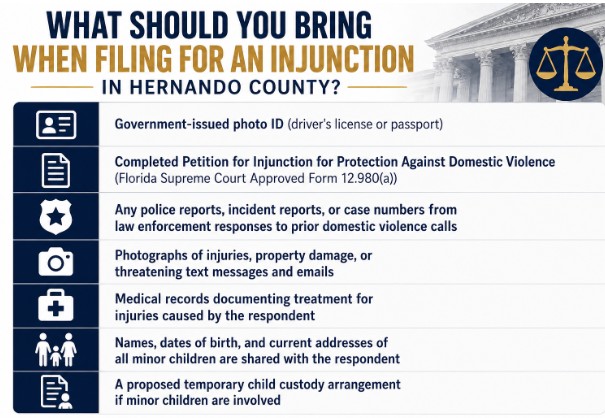
Filing an injunction petition at the Hernando County Courthouse requires specific documentation and personal identification. Petitioners who arrive without the required materials risk delays that leave them unprotected during the most critical hours after filing.
The Hernando County Clerk of the Circuit Court provides injunction petition forms at the courthouse, and the Florida Courts publishes the approved forms online for advance preparation, so petitioners can complete the sworn petition before arriving at the courthouse.
Mulligan & Associates recommends that every petitioner bring the following items to the filing:
- Government-issued photo ID (driver’s license or passport)
- Completed Petition for Injunction for Protection Against Domestic Violence (Florida Supreme Court Approved Form 12.980(a))
- Any police reports, incident reports, or case numbers from law enforcement responses to prior domestic violence calls
- Photographs of injuries, property damage, or threatening text messages and emails
- Medical records documenting treatment for injuries caused by the respondent
- Names, dates of birth, and current addresses of all minor children are shared with the respondent
- A proposed temporary child custody arrangement if minor children are involved
The Hernando County divorce and family court process requires similar documentation for financial and custody matters, so petitioners involved in both an injunction case and a pending divorce should coordinate filings to avoid conflicting court orders.
Every hour without a protective order increases risk — reach out to Mulligan & Associates to prepare your injunction petition with experienced Brooksville attorneys.
What Happens After Law Enforcement Serves the Temporary Injunction?
The temporary injunction becomes enforceable the moment the Hernando County Sheriff’s Office serves the respondent with the signed court order.
Service triggers immediate legal obligations: the respondent must comply with every term of the injunction from the instant of service, including no-contact provisions, distance requirements, and any temporary custody or exclusive use of the residence provisions.
Immediate Obligations on the Respondent
The temporary injunction order typically prohibits the respondent from contacting the petitioner by phone, text, email, social media, or through third parties.
Florida Statutes Section 741.30(6)(a) authorizes judges to include provisions that require the respondent to vacate a shared residence, surrender firearms to local law enforcement, and stay at least 500 feet from the petitioner’s home, workplace, and school.
A respondent who has been served with a temporary injunction and shares child custody with the petitioner must follow any temporary timesharing provisions in the order.
Hernando County judges frequently include temporary custody language in domestic violence injunctions to protect minor children during the period between service and the full hearing.
The Return Hearing Within 15 Days
Florida Statutes Section 741.30(5)(c) requires the court to schedule a full evidentiary hearing within 15 days of the temporary injunction. Both the petitioner and the respondent attend the return hearing, present testimony, call witnesses, and submit evidence. The judge then decides whether to enter a final injunction — which can last indefinitely under Florida law — or dissolve the temporary order.
How Does an Injunction Affect Child Custody and Timesharing?
A domestic violence injunction directly impacts child custody determinations in Florida. Florida Statutes Section 61.13(2)(c)(2) requires family court judges to consider evidence of domestic violence as a factor in the best-interest-of-the-child analysis when establishing or modifying parenting plans.
A temporary injunction can include emergency custody provisions that grant the petitioner sole temporary custody of minor children, suspend or restrict the respondent’s timesharing, and prohibit the respondent from removing the children from the petitioner’s care.
Hernando County judges include these provisions when the sworn petition alleges that the respondent’s conduct poses a risk to the children’s safety.
How a Final Injunction Carries Into Custody Proceedings
A final injunction entered after the return hearing creates a documented judicial finding of domestic violence that carries significant weight in any subsequent custody case.
A Hernando County child custody attorney can present the final injunction as evidence in a pending or future divorce proceeding, and the family court judge must consider the injunction when evaluating parental fitness under Florida Statutes Section 61.13.
Florida’s rebuttable presumption under Section 61.13(2)(c)(2) holds that shared parental responsibility is detrimental to the child when a court has made a finding of domestic violence.
The parent subject to a final injunction carries the burden of overcoming that presumption before a judge will award shared custody.
What Happens If the Respondent Violates a Temporary Injunction?
Violating any term of a temporary or final injunction for protection is a first-degree misdemeanor under Florida Statutes Section 741.31. A first-degree misdemeanor in Florida carries penalties of up to one year in county jail, up to 12 months of probation, and a fine of up to $1,000 under Florida Statutes Section 775.083.
Law enforcement officers have mandatory arrest authority under Florida Statutes Section 901.15(6) when they have probable cause to believe a respondent has violated an injunction for protection.
The Hernando County Sheriff’s Office does not need a new warrant to arrest a respondent who violates a served injunction — the officer arrests the respondent at the scene based on probable cause alone.
Common Violations That Trigger Arrest
A respondent who sends a single text message to the petitioner, drives past the petitioner’s residence, or appears at the petitioner’s workplace violates the injunction’s no-contact and stay-away provisions.
Hernando County law enforcement treats each individual violation as a separate arrestable offense. A respondent who contacts the petitioner three times in one day faces three separate criminal charges under Section 741.31.
Petitioners who experience a violation should call 911 immediately, document the violation with screenshots or photographs, and contact a Hernando County family law attorney to file a motion for contempt in the civil injunction case.
Frequently Asked Questions
How quickly can I get a temporary injunction in Hernando County?
Hernando County circuit court judges typically review domestic violence injunction petitions the same business day the petitioner files with the Clerk of the Circuit Court. Florida Statutes Section 741.30 requires review “as soon as possible,” and most temporary injunctions are signed within 24 hours of filing.
Does filing for an injunction cost anything in Florida?
Filing a Petition for Injunction for Protection Against Domestic Violence carries no filing fee under Florida Statutes Section 741.30. The Hernando County Clerk of the Circuit Court processes injunction petitions at no cost to the petitioner, and law enforcement serves the order without charging a service fee.
Can I get temporary custody of my children through an injunction?
Florida Statutes Section 741.30(6)(a) authorizes judges to include temporary exclusive custody provisions in a domestic violence injunction. The judge may grant the petitioner temporary sole custody, restrict the respondent’s timesharing, and prohibit the respondent from removing children from the petitioner’s care.
What happens at the 15-day return hearing?
Both the petitioner and the respondent appear before the Hernando County circuit court judge at the return hearing scheduled under Florida Statutes Section 741.30(5)(c). Each party presents testimony, calls witnesses, and submits evidence before the judge decides whether to enter a final injunction.
How long does a final injunction last in Florida?
A final injunction for protection against domestic violence can remain in effect indefinitely under Florida law. The respondent may file a motion to dissolve or modify the injunction, but bears the burden of demonstrating a substantial change in circumstances warranting modification.
What should I do if the respondent violates the injunction?
A petitioner who experiences an injunction violation should call 911 immediately and document the violation with screenshots, photographs, or witness statements. Florida Statutes Section 741.31 classifies violations of injunctions as first-degree misdemeanors, and law enforcement has mandatory arrest authority under Section 901.15(6).
Can the respondent contact me through a third party during a temporary injunction?
A temporary injunction that includes a no-contact provision prohibits both direct and indirect contact. A respondent who sends messages through a friend, family member, or coworker violates the injunction’s no-contact terms and faces arrest under Florida Statutes Section 741.31.
Do I need a lawyer to file for an injunction in Hernando County?
Florida law does not require legal representation to file for an injunction for protection. Petitioners may file using Florida Supreme Court Approved Family Law Forms available at the Hernando County Courthouse. Mulligan & Associates recommends legal counsel for cases involving child custody provisions or contested return hearings.
Will an injunction show up on a background check?
A final injunction for protection entered by a Florida circuit court becomes a public court record. Employers, landlords, and licensing agencies conducting background checks through the Hernando County Clerk’s records or the Florida Department of Law Enforcement database can access final injunction records.
Can I file for an injunction if my divorce is already pending?
A petitioner may file for an injunction for protection at any time, regardless of whether a divorce case is pending in Hernando County or any other Florida court. The injunction proceeding operates on a separate civil docket, and the family court judge in the divorce case must consider any active injunction when ruling on custody and timesharing.

About the Author
Christopher S. Mulligan
Florida Bar Member in Good Standing since November 9, 2007 (Bar No. 47524) · J.D., The George Washington University Law School, 2006
Christopher S. Mulligan is a third-generation Florida attorney and founder of Mulligan & Associates in Brooksville, Florida. He drafted provisions of the 2005 Violence Against Women Act reauthorization and serves as a Guardian ad Litem and Attorney ad Litem for children in foster care. He has practiced family law in Hernando County since 2007 and represents families in divorce, custody, support, adoption, dependency, and injunction matters throughout the Fifth Judicial Circuit.