
Homosassa Springs, FL Divorce Attorney

Christopher S. Mulligan, Esq. represents Homosassa Springs residents filing for divorce in Citrus County, part of Florida’s Fifth Judicial Circuit.
Florida allows no-fault divorce under Fla. Stat. §61.052, requiring six months of Florida residency under Fla. Stat. §61.021 before either spouse may file.
Mulligan & Associates handles equitable distribution, alimony, and child custody filings through the Citrus County Clerk of Court in Inverness.
Key Takeaways
- Citrus County divorce filings are processed through the Fifth Judicial Circuit’s Family Law Division at the courthouse in Inverness.
- Fla. Stat. §61.021 requires six months of state residency before either spouse can file a divorce petition.
- Fla. Stat. §61.075 directs judges to begin with an equal split of marital assets, adjusting only when one of ten statutory factors justifies an unequal division.
- The 2023 reform under Fla. Stat. §61.08 eliminated permanent alimony, replacing it with four capped support categories. The dollar cap on durational alimony — 35% of the difference in net incomes — applies only after a court first finds actual need and the other spouse’s ability to pay.
- Florida law no longer uses “custody.” Parental responsibility (decision-making authority) and time-sharing (the physical schedule) are addressed together in a court-approved parenting plan.
- Citrus County is significantly older than Florida as a whole — a factor that shapes how retirement assets and long-term financial planning come up in local divorce cases.
Why Does Homosassa Springs Divorce Require Fifth Judicial Circuit Experience?
Homosassa Springs divorces often involve retirement assets, waterfront property, and the practical realities of a small, close-knit community — factors a general Florida attorney may not routinely encounter.
Local Family Dynamics in Homosassa Springs
Citrus County’s population skews significantly older than the state average: the county’s median age is roughly 57, compared with about 43 statewide, and residents 65 and older make up approximately 36–37% of the population versus roughly 22% statewide, according to 2024 American Community Survey estimates (Citrus County Chronicle, citing U.S. Census data).
In practice, that means retirement accounts, pensions, and waterfront or vacation property come up often in Homosassa Springs-area divorce cases, and privacy is a real concern for clients in a small community where people know each other.
Citrus County Courthouse Procedures
Filing for dissolution of marriage in Citrus County means working within the Fifth Judicial Circuit’s scheduling practices and its mediation program, administered through Circuit 5’s Citrus County mediation services. Mulligan has practiced in the Fifth Judicial Circuit since being admitted to the Florida Bar in 2007.
Common Mistakes Without Local Counsel
Self-represented Homosassa Springs residents can run into trouble by undervaluing retirement accounts, agreeing to time-sharing terms they later regret, or missing the mandatory financial disclosure deadline required under Florida Family Law Rule 12.285. These are the kinds of errors that are difficult and costly to unwind once a final judgment is entered, which is why an early legal review can matter.
What Are Florida’s No-Fault Divorce Requirements?
Florida requires no proof of wrongdoing to dissolve a marriage, but two statutory thresholds must be met before a Citrus County judge will grant the petition.
Six-Month Residency Rule
Fla. Stat. §61.021 requires one spouse to reside in Florida for six months before filing. Under §61.052(2), that residency can be corroborated at the final hearing by a valid Florida driver’s license, a Florida voter’s registration card, a Florida ID card, or the testimony or affidavit of a third party — this is the evidence used to satisfy the court that residency is met, not a checklist for what to file with the initial petition.
The Irretrievably Broken Standard
Under Fla. Stat. §61.052, a Citrus County judge grants dissolution once satisfied that the marriage is irretrievably broken. Neither spouse must prove fault, misconduct, or wrongdoing — a marked difference from the fault-based divorce systems some states still use.
How Does Equitable Distribution Divide Marital Assets in Citrus County?
Equitable distribution is Florida’s legal framework for fairly, though not necessarily equally, dividing marital property between divorcing spouses under Fla. Stat. § 61.075.
Ten Statutory Factors Courts Weigh
Fla. Stat. §61.075 lists factors a Citrus County judge must weigh before ordering an unequal division, including each spouse’s economic circumstances, contribution to the marriage, and any intentional dissipation, waste, or destruction of marital assets after the petition is filed or within two years before it was filed.
Judges must issue written findings addressing the applicable factors, so each spouse can see the reasoning behind an unequal award.
Retirement Accounts and Waterfront Property
| Asset Type | Common Division Method | Typical Complication |
| Pension / 401(k) (employer-sponsored, ERISA-qualified plans) | Qualified Domestic Relations Order (QDRO) | Requires a separate court order and plan administrator approval |
| IRA / Roth IRA | Transfer incident to divorce under IRC §408(d)(6) — authorized by the divorce decree itself, no QDRO required | Must be handled correctly to avoid triggering early-withdrawal tax consequences |
| Waterfront or vacation property | Independent appraisal, then sale or buyout | Valuation disputes over Gulf Coast market conditions |
| Family-owned business | Forensic business valuation | Determining marital vs. separate ownership share |
| Retirement accounts opened pre-marriage | Coverture fraction calculation | Separating marital growth from pre-marital principal |
A pension or 401(k) is divided by a QDRO because those plans are governed by federal ERISA rules. An IRA is not an ERISA-qualified plan, so it’s divided directly under the terms of the divorce decree — no QDRO is needed or applicable.
What Alimony Options Exist After Florida’s 2023 Reform?
Florida eliminated permanent alimony for divorces filed on or after July 1, 2023, under Fla. Stat. §61.08, replacing it with four forms: temporary, bridge-the-gap, rehabilitative, and durational.
For durational alimony specifically, the court sets the award at whichever is less: the recipient’s demonstrated reasonable need, or 35% of the difference between the spouses’ net incomes.
That 35% figure is a ceiling, not an entitlement — the court must first find that the requesting spouse has an actual need and the other spouse has the ability to pay before the cap even comes into play. Durational alimony is also unavailable for marriages of less than three years.
| Alimony Type | Purpose | Maximum Duration |
| Temporary | Support during pending litigation | Ends at final judgment |
| Bridge-the-gap | Short-term transition to single life | 2 years maximum |
| Rehabilitative | Funds a specific job training or education plan | Tied to the rehabilitation plan |
| Durational | Fixed-term support after the marriage ends, capped at the lesser of need or 35% of net income difference | 50% of marriage length (under 10 years); 60% (10–20 years); 75% (20+ years); unavailable under 3 years |
Marriages ending after decades face new alimony caps under Florida’s 2023 reform, and the interaction between the durational cap and the underlying need-and-ability analysis is something worth discussing directly with counsel rather than estimating from the formula alone.
How Are Parental Responsibility and Time-Sharing Determined in Citrus County Courts?
Florida no longer uses the term “custody.” Since 2008, Florida law has addressed two separate concepts instead: parental responsibility (who makes major decisions about the child’s health, education, and welfare) and time-sharing (the physical schedule of when the child is with each parent).
Both are documented together in a court-approved parenting plan under Fla. Stat. §61.13.
Best-Interest Factors Citrus County Judges Weigh
§61.13 directs judges to order shared parental responsibility unless shared responsibility would be detrimental to the child — evidence of domestic violence is one of the factors the court must consider in that determination.
Judges also weigh the child’s school enrollment, established community ties, and each parent’s demonstrated willingness to facilitate the other parent’s relationship with the child.
Modifying a Parenting Plan After Divorce
Citrus County parents may petition the Fifth Judicial Circuit to modify an existing parenting plan or time-sharing schedule, but only upon a showing of a substantial and material change in circumstances and a finding that the modification is in the child’s best interest.
This is the current standard under §61.13(3) — note that child support and alimony modifications are governed by separate statutes with their own standards, so a change that qualifies for one type of modification doesn’t automatically apply to another.
Contested vs. Uncontested Divorce: Which Applies in Homosassa Springs?
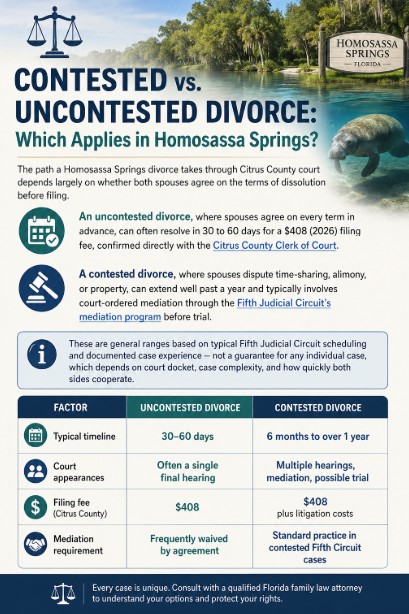
The path a Homosassa Springs divorce takes through Citrus County court depends largely on whether both spouses agree on the terms of dissolution before filing.
An uncontested divorce, where spouses agree on every term in advance, can often resolve in 30 to 60 days for a $408 (2026) filing fee, confirmed directly with the Citrus County Clerk of Court.
A contested divorce, where spouses dispute time-sharing, alimony, or property, can extend well past a year and typically involves court-ordered mediation through the Fifth Judicial Circuit’s mediation program before trial.
These are general ranges based on typical Fifth Judicial Circuit scheduling and documented case experience — not a guarantee for any individual case, which depends on court docket, case complexity, and how quickly both sides cooperate.
| Factor | Uncontested Divorce | Contested Divorce |
| Typical timeline | 30–60 days | 6 months to over 1 year |
| Court appearances | Often a single final hearing | Multiple hearings, mediation, possible trial |
| Filing fee (Citrus County) | $408 | $408 plus litigation costs |
| Mediation requirement | Frequently waived by agreement | Standard practice in contested Fifth Circuit cases |
What Local Resources Support Homosassa Springs Divorce Clients?
Homosassa Springs residents navigating divorce can draw on both court-based and community-based resources throughout Citrus County.
Citrus County Courthouse — Family Law Division
The Citrus County Courthouse at 110 N Apopka Ave, Inverness, FL 34450 processes dissolution filings, time-sharing hearings, and post-judgment modifications for Homosassa Springs residents through the Fifth Judicial Circuit.
Community Counseling and Support Services
Citrus County Support Services Division offers counseling referrals and crisis intervention. The Centers, Inc. provides family counseling and behavioral health services. CASA Citrus County assists individuals navigating domestic transitions.
Statewide Child Support and Custody Resources
The Florida Department of Revenue’s Child Support Program processes payment enforcement, while the Florida Courts Family Law Self-Help Center publishes required forms for pro se filers.
Frequently Asked Questions
How do I file for divorce in Homosassa Springs, FL?
A Homosassa Springs resident files for divorce at the Citrus County Courthouse in Inverness. The petitioner submits a Petition for Dissolution of Marriage to the Clerk of the Circuit Court, pays the filing fee, and arranges service on the other spouse under the Florida Family Law Rules of Procedure (Rule 12.070), which govern service of process in family law cases.
How long must I live in Florida before filing?
Florida’s residency requirement under Fla. Stat. § 61.021 requires that one spouse have lived in the state for 6 months before filing. At the final hearing, that residency is typically corroborated by a Florida driver’s license, voter registration card, Florida ID card, or a sworn third-party affidavit or testimony under §61.052(2).
How long does a Homosassa Springs divorce take?
An uncontested Citrus County divorce with a signed marital settlement agreement often finalizes in 30 to 60 days. Contested cases involving disputed time-sharing, alimony, or asset division can take six months to a year or more, depending on the Fifth Judicial Circuit’s mediation and hearing schedule — these are typical ranges, not guaranteed outcomes.
What does it cost to file for divorce in Citrus County?
The Citrus County Clerk of the Circuit Court and County Comptroller charges $408 to file a Petition for Dissolution of Marriage. Additional costs may include service of process fees, mediation costs, and attorney fees, which vary based on whether the divorce is contested or uncontested.
How does Florida divide marital property?
Fla. Stat. §61.075 directs Citrus County judges to begin with an equal split of marital assets and liabilities. Judges adjust that starting point only when statutory factors — such as each spouse’s contribution, economic circumstances, or intentional dissipation of assets — justify an unequal distribution.
What alimony can Citrus County courts still award?
Florida eliminated permanent alimony for cases filed after July 1, 2023, under Fla. Stat. §61.08. Citrus County judges may award temporary, bridge-the-gap, rehabilitative, or durational alimony. For durational alimony, the amount is capped at the lesser of the recipient’s reasonable need or 35% of the difference between both spouses’ net incomes — but only once the court has found actual need and the other spouse’s ability to pay.
How are parental responsibility and time-sharing decided in Citrus County?
Citrus County courts apply Florida’s best-interest-of-the-child standard under §61.13. Judges generally favor shared parental responsibility, weighing each parent’s ability to communicate, the child’s school and community ties, and any evidence of domestic violence before approving a parenting plan that sets out both decision-making authority and the time-sharing schedule.
Can I modify a parenting plan, support, or alimony after divorce?
Florida law allows modification of a parenting plan or time-sharing schedule on a showing of a substantial and material change in circumstances, along with a best-interest finding. Child support and alimony modifications are governed by separate statutes with their own standards. Citrus County residents petition the same Fifth Judicial Circuit court that entered the original order.
How are retirement accounts divided in a Homosassa Springs divorce?
Employer-sponsored plans like pensions and 401(k)s are typically divided through a Qualified Domestic Relations Order. IRAs are handled differently — they’re divided directly through the divorce decree as a “transfer incident to divorce,” and a QDRO is neither required nor applicable. Waterfront property and family businesses in Citrus County often require independent appraisal before a judge finalizes the distribution.
What is a parenting plan in Florida?
Florida law replaced “custody” with two distinct concepts — parental responsibility (decision-making authority) and time-sharing (the physical schedule) — both of which are set out together in a court-approved parenting plan under §61.13.
A Homosassa Springs divorce affects finances, family, and community standing all at once. Mulligan & Associates offers consultations to Citrus County residents ready to move forward.