
Child Custody Attorney in Brooksville and Hernando County, FL

When custody is on the line, it is not a scheduling issue. It feels like your role as a parent is being negotiated in real time. The fear is specific. Missing school mornings. Losing weekends.
Watching decisions get made without you. If the other parent is controlling access, changing plans at the last minute, or threatening to “take the kids,” you need a plan that is realistic, enforceable, and built for court.
Mulligan & Associates helps Hernando County parents build strong parenting plans using Florida’s time-sharing and parental responsibility framework. We focus on what actually reduces stress.
Clear schedules, clean exchanges, decision-making rules, and boundaries that prevent the same fight from repeating every week.
You are in the right place if:
- You are worried you will lose time with your child, and you want a time-sharing plan that holds up.
- You need a custody order modified or enforced because the current plan is not being followed.
- You need a modification, enforcement, or relocation plan that protects stability.
Schedule a confidential consultation to protect your parenting time, clarify next steps, and stop costly mistakes. Contact us today or call 352-593-5990.
What Child Custody Means in Florida
In Florida, “custody” usually means two things. Parental responsibility, who makes major decisions, and time-sharing, how parenting time is divided between households.
Courts approve or set a parenting plan and time-sharing schedule based on the child’s best interests. The goal is stability and safety, not winning. If the current setup feels unworkable, a clear plan is the first fix.
Who We Help in Brooksville
Custody stress is different from other legal stress. It hits every week. Every exchange. Every school night.
We help parents who need a plan that protects their relationship with their child and reduces day-to-day conflict, even when communication with the other parent is difficult.
- Parents separating who need a first-time parenting plan
- High-conflict co-parenting with constant texting, threats, or last-minute changes
- Unequal involvement, safety concerns, substance issues, or unstable routines
- Parents seeking a modification after a major life change
- Parents needing enforcement when orders are ignored
- Parents facing relocation impacts or schedule breakdowns
What We Do. Parenting Plans That Work in Real Life

We build custody cases around stability, logistics, and credible documentation. That means creating a schedule your child can actually live with, clarifying decision-making, and presenting facts in a way the court can use.
When support is part of the pressure, we align the time-sharing plan with child support in Brooksville so nothing conflicts.
If custody is coming up during divorce, we coordinate the plan with your Brooksville divorce case to keep decisions consistent and enforceable.
Time-Sharing and Parental Responsibility. The Two Decisions Courts Focus On
Time-sharing is the schedule. Parental responsibility is who makes major decisions. The strongest plans remove ambiguity.
Where the child is on school nights, how exchanges happen, who attends appointments, how travel works, and how disagreements are handled without constant conflict.
When the plan is specific, it reduces weekly arguments and protects your parenting time from “gray area” games.
| Topic | What it controls | What people fight about | What a strong plan includes |
| Time-sharing | Where the child is and when | Weekends, holidays, overnights | School-week structure, holidays, exchanges |
| Parental responsibility | Major decisions | School, medical, activities | Decision rules, notice timelines, tie-break method |
How Child Custody Works in Florida. The 6 Step Roadmap
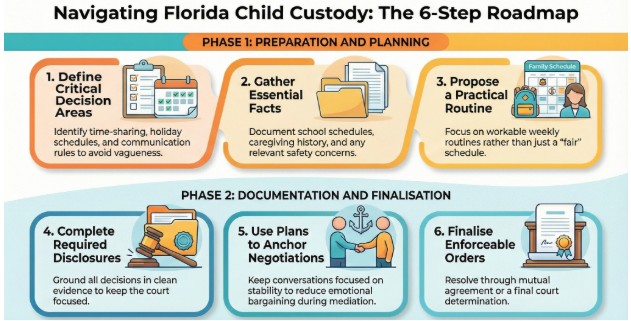
Florida custody follows a predictable sequence. Clarify the issues, gather facts, propose a workable parenting plan, complete required disclosures, negotiate or mediate where possible, then finalize through agreement or court order.
Getting the early steps right reduces rework and protects your leverage, especially when the other parent is unpredictable or conflict is escalating.
- Define what must be decided
Time-sharing, decision-making, holidays, exchanges, and communication rules so nothing important is left vague. - Gather the facts that matter
School schedules, caregiving history, communication patterns, and any safety concerns. This guide summarizes custody laws in Florida and the terms courts use. - Propose a parenting plan that fits real life
Not just a “fair” schedule. A workable routine the child can follow week to week, including transitions and school nights. - Complete required disclosures and documentation
Decisions should be grounded in evidence. Clean records reduce conflict and help the court focus on the child, not accusations. - Negotiate or mediate with the plan as the anchor
A clear plan reduces emotional bargaining and keeps conversations focused on solutions and stability. - Finalize orders by agreement or court determination
If you settle, the agreement becomes enforceable. If you do not, the court decides based on the child’s best interests.
What Courts Consider. Best Interests, Safety, and Stability
Florida custody decisions are guided by the child’s best interests. Courts look at safety, stability, and each parent’s ability to meet the child’s needs and support a consistent routine.
If there are credible safety concerns, the strategy must protect the child and create clear boundaries, because vague plans leave room for repeat conflict.
- Stability of routine, school, and home environment
- Ability to co-parent and communicate without constant conflict
- History of caregiving and follow-through
- Practical logistics. Work schedules, transportation, exchanges
- Safety risks. Violence, substance concerns, unsafe associates
- Child needs. Medical, educational, developmental
If safety is a factor, options like Brooksville restraining orders may help stabilize boundaries while custody is being addressed.
Modifying Custody Orders. When a Change Is Possible
A custody order is not automatically changeable because life got harder. Florida generally requires a substantial change in circumstances and a showing that the modification is in the child’s best interests.
Start with the real reason the schedule is breaking down, then build the evidence that supports a new plan.
| Reason people request modification | What you must show | Common mistake |
| Schedule no longer works | Real impact on the child’s routine | Focusing on parent convenience only |
| Relocation | Impact and realistic alternatives | Moving before a plan is set |
| Safety concerns | Credible facts and documentation | Relying on allegations without proof |
Enforcing Custody Orders. What to Do When the Other Parent Will Not Follow Them
Enforcement is about stopping the slow erosion of your parenting time. When orders are ignored, late, or weaponized, your next move should be documented and strategic.
The goal is to restore predictability for the child and reduce opportunities for gamesmanship, without getting pulled into constant emotional arguments that go nowhere.
- Missed exchanges or repeated lateness
- Withholding the child or blocking communication
- Unapproved travel or schedule manipulation
- Refusing agreed school or medical coordination
- “Make-up time” promises that never happen
- Rewriting the schedule by text message
Consultation Checklist. What to Bring, What to Prepare
The fastest way to reduce delays is to show up with clean documents and a clear snapshot of your child’s routine and your co-parenting reality.
Bring what you can now. We can fill gaps later. Starting with accurate schedules, communication patterns, and key records helps you negotiate from a position of strength and reduces the chance that the other parent controls the narrative.
| What to bring or prepare | Why it matters |
| Child’s school and activity schedule, plus childcare details | Shows the child’s real routine and helps build a workable time-sharing plan |
| Your work schedule and availability | Keeps proposals realistic and reduces future schedule breakdowns |
| Current informal schedule and what is not working | Identifies the exact friction points the plan must fix |
| Communication examples that show the pattern, not one bad day | Helps establish credibility and reduce “he said, she said” arguments |
| Travel constraints, transportation plan, exchange locations | Prevents exchange disputes and protects consistency for the child |
| Any safety concerns and related paperwork | Supports boundaries and safety planning when risk is involved |
| Prior court orders or pending cases | Prevents conflicts between orders and clarifies what is already enforceable |
| Child’s medical or educational needs documentation | Ground decisions in the child’s needs, not parent preferences |
| Your top 3 outcomes and top 3 dealbreakers | Keeps strategy focused and negotiations efficient |
| A draft schedule you believe is realistic | Gives a starting point and signals preparation and seriousness |
| Notes on missed time-sharing or recurring problems | Creates a clean timeline of issues that supports enforcement or modification |
| Names of key professionals involved if relevant (teachers, counselors, doctors) | Helps document needs and coordination points for the parenting plan |
If child support is tied to time-sharing disputes, aligning the schedule with child support in Brooksville can prevent conflicts later.
Frequently Asked Questions
What is the difference between time-sharing and parental responsibility in Florida?
Time-sharing is the schedule. where the child lives on school nights, weekends, holidays, and exchanges. Parental responsibility involves decision-making on major issues such as school and medical care. A strong parenting plan defines both clearly to reduce conflict and prevent constant renegotiation.
How does a judge decide a custody schedule in Florida?
A Florida judge sets a custody schedule based on the child’s best interests and stability. The court weighs practical caregiving history, safety, and whether the plan fits the child’s routine. Specific schedules for school nights, exchanges, holidays, and transportation tend to work best.
Can a custody order be changed after it is final?
A final custody order can be changed, but not just because a parent is unhappy. Florida generally requires a substantial change in circumstances and that the modification benefits the child. Start by identifying what changed, then document how it affects the child’s routine.
What counts as a substantial change in circumstances for custody modification?
A substantial change is a major, lasting shift that affects the child’s stability or well-being. Examples include relocation impacts, safety concerns, repeated violations, or a schedule that no longer fits school and childcare. The key is proving real child-focused impact, not convenience.
What can I do if the other parent keeps violating the custody schedule?
Custody violations should be handled with calm documentation and enforcement. Track missed exchanges, late returns, denied contact, and communication patterns, then pursue court enforcement of the order. The goal is to restore predictability for the child and stop informal schedule rewrites.
How does relocation affect a parenting plan and time-sharing schedule?
Relocation affects custody by altering school routines, travel time, and exchange arrangements. A workable relocation plan usually requires a revised schedule and transportation rules. The biggest mistake is moving first and trying to fix the parenting plan later.
When is a Guardian ad Litem involved in a custody case?
A Guardian ad Litem may be appointed when the court wants an independent view of the child’s best interests. This is more common in high-conflict cases, safety allegations, or complex child needs. The Guardian may review records and make recommendations.
Related Family Law Services in Brooksville
Custody stress rarely stays in one lane. It spills into divorce decisions, support numbers, and safety concerns. Pick the path that matches what’s driving the conflict right now, so you can stop chasing answers across the internet and start building a plan that holds.
- If custody is being negotiated in your divorce, maintain consistency in your Brooksville divorce case.
- If the schedule and the money are tied together, align time-sharing with child support in Brooksville.
- If conflict is escalating and you need safer boundaries, review Brooksville restraining orders.
- If a child protection case is involved and the stakes feel immediate, speak with a dependency attorney in Brooksville.
- If your family is growing and you want it done the first time, explore a Brooksville adoption attorney.
Talk to Mulligan & Associates. Confidential Consultation
Your first call is not about telling a long story. It is about getting clarity and control. We will identify parenting time risks, immediate stability needs, and what to document next.
You will know what to bring, what to stop doing, and what the next step is to protect your position and your child’s routine.
Schedule a confidential consultation: Call now: 352-593-5990