
Dependency Attorney in Brooksville, FL — Mulligan & Associates

A Florida dependency case is initiated under Florida Chapter 39 when DCF determines a child faces abuse, abandonment, or neglect and files a petition with the circuit court.
Christopher S. Mulligan, Esq., a Brooksville dependency attorney admitted to the Florida Bar in 2007, represents parents in dependency proceedings, termination of parental rights cases, and DCF investigations before the Fifth Judicial Circuit.
Florida dependency cases move fast — a shelter hearing must occur within 24 hours of a child’s removal under Florida Statute § 39.402. Parents who appear without an attorney at that first hearing risk losing the ability to shape every proceeding that follows.
Retain Mr. Mulligan before the shelter hearing by calling 352-593-5990. Time is not on your side at this stage.
What Is a Dependency Case in Florida
A dependency case is a court proceeding in which the Hernando County Circuit Court determines whether a child has been abused, abandoned, or neglected under Florida Chapter 39.
The Florida Department of Children and Families — commonly called DCF — investigates abuse reports filed through the Florida Abuse Hotline and files a dependency petition when the agency determines a child faces imminent risk.
Florida Chapter 39 governs the entire dependency process, from the initial DCF investigation through case plan compliance, reunification, and, when reunification fails, termination of parental rights.
A parent named in a dependency petition faces potential loss of custody and parental rights — the most consequential outcome in family law.
What Triggers a DCF Investigation in Hernando County
DCF opens a child protective investigation when a caller reports suspected abuse, abandonment, or neglect to the Florida Abuse Hotline.
The hotline operates 24 hours a day, seven days a week. A child protective investigator or law enforcement officer responds to the family home to assess the child’s safety.
If the investigator determines the child faces imminent danger, DCF may remove the child from the home without a court order under Florida Statute § 39.401 and place the child in emergency shelter care.
How Does a Dependency Case Progress Through the Hernando County Court
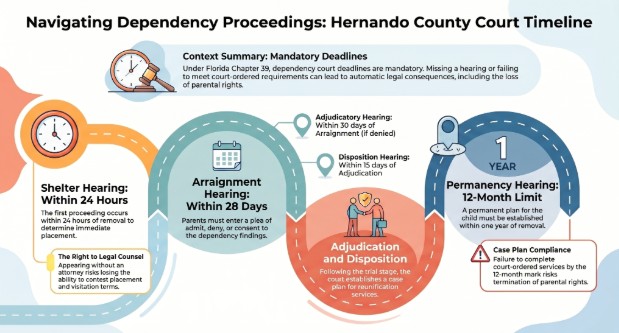
Florida Chapter 39 deadlines are mandatory — missing a hearing produces automatic legal consequences under Florida Statute § 39.506, including deemed consent to a dependency adjudication.
Shelter Hearing — Within 24 Hours of Removal
The shelter hearing is the first court proceeding in a dependency case and must occur within 24 hours of a child’s removal under Florida Statute § 39.402. The Hernando County Circuit Court determines at the shelter hearing whether the child should remain in DCF shelter care or return home pending further proceedings.
A parent who appears at the shelter hearing without an attorney loses the opportunity to contest placement and visitation terms at the most critical early stage.
Arraignment Hearing — Within 28 Days of Shelter Hearing
The arraignment hearing must be held no later than 28 days after the shelter hearing under Florida Statute § 39.506. A parent enters one of three pleas at arraignment: admit, deny, or consent to the findings of dependency alleged in the DCF petition.
A parent who admits or consents proceeds directly to a disposition hearing within 15 days. A parent who denies the allegations triggers an adjudicatory hearing within 30 days of the arraignment date under Florida Statute § 39.506.
Adjudicatory Hearing — Within 30 Days of Arraignment
The adjudicatory hearing is the trial stage of a Florida dependency case. The Hernando County Circuit Court reviews all evidence and determines whether the facts support the dependency allegations in the DCF petition. A finding of dependency at the adjudicatory hearing moves the case to the disposition stage and begins the case plan process.
Disposition Hearing — Within 15 Days of Adjudication
The disposition hearing determines the child’s placement and the terms of the case plan under Florida Statute § 39.521. The court establishes the services and conditions a parent must complete to achieve reunification — substance abuse treatment, parenting classes, domestic violence counseling, or other services the court identifies at the disposition hearing.
Permanency Hearing — Within 12 Months of Shelter Placement
The permanency hearing must occur within 12 months of the date the child entered shelter care under Florida Statute § 39.621, and every 6 months thereafter under Florida Statute § 39.701.
The court determines the child’s permanent plan — reunification with the parent, adoption, permanent guardianship, or placement with a suitable relative.
A parent who has not substantially completed the case plan by the 12-month permanency hearing faces an elevated risk of a termination of parental rights petition.
Mr. Mulligan appears at every stage of the dependency process for parents in Hernando County, so no deadline passes without legal representation.
A DCF case plan does not move forward on its own — every missed hearing, unfiled objection, or uncontested placement decision narrows the path back to reunification. Schedule a consultation at 352-593-5990 before the arraignment hearing.
What Happens If a Parent Does Not Comply With a Florida Case Plan
Florida Statute § 39.806 authorizes DCF to file a petition to terminate parental rights when a parent fails to substantially comply with the court-ordered case plan within 12 months of the child’s removal.
Termination of parental rights permanently ends the legal relationship between a parent and child — the most severe outcome available in the Florida family court.
A parent who misses case plan appointments, fails drug tests, or stops attending court-ordered services gives DCF documented grounds to file a termination petition.
Mr. Mulligan monitors case plan compliance for clients throughout Hernando County and files timely motions when DCF overreaches or mischaracterizes a parent’s progress.
What Florida Courts Consider Before Terminating Parental Rights
The Hernando County Circuit Court evaluates whether termination of parental rights serves the child’s manifest best interests under Florida Statute § 39.810.
The court weighs the parent’s history of compliance, the bond between parent and child, the child’s need for permanency, and whether termination serves the child’s long-term welfare.
A parent with a documented case plan progress — even incomplete — is in a stronger position at a termination hearing than a parent who stopped engaging with services.
How Much Does a Dependency Attorney Cost in Hernando County
Florida dependency cases involve court-appointed counsel in some circumstances, but parents who retain private counsel maintain direct control over their defense strategy.
Hernando County family law attorneys typically charge retainer fees and hourly rates consistent with the Fifth Judicial Circuit market. Mr. Mulligan discusses fees and retainer requirements at the initial consultation.
Court-appointed attorneys are available for parents who qualify financially under Florida Statute § 39.402 (2025), which requires the court to advise parents of the right to counsel at the shelter hearing.
Parents who do not qualify for appointed counsel and who represent themselves in dependency proceedings face DCF attorneys and child welfare professionals with years of institutional experience in Hernando County court.
Frequently Asked Questions
What is a dependency case in Florida?
A dependency case is a civil proceeding under Florida Chapter 39 in which the circuit court determines whether a child has been abused, abandoned, or neglected. DCF files the petition after a child protective investigation, and the court may establish a case plan, order reunification, or terminate parental rights.
How quickly does a Florida dependency case move after a child is removed?
Florida Statute § 39.402 requires a shelter hearing within 24 hours of removal. The arraignment hearing follows within 28 days under Florida Statute § 39.506, and an adjudicatory hearing must occur within 30 days of arraignment. Florida Chapter 39 deadlines are mandatory — missing a hearing produces automatic legal consequences, including deemed consent to dependency findings.
What are my rights as a parent in a Hernando County dependency case?
Florida law gives parents the right to legal counsel, to contest allegations at the adjudicatory hearing, and to present evidence and witnesses. Florida Statute § 39.402 requires the court to advise parents of their right to counsel at the shelter hearing. Parents who cannot afford an attorney may qualify for court-appointed representation under Florida Chapter 39.
What does DCF have to prove to remove a child from the home in Florida?
DCF must establish an imminent risk of harm from abuse, abandonment, or neglect under Florida Statute § 39.401 to remove a child without a court order. At the shelter hearing, the Hernando County Circuit Court determines whether probable cause supports continued out-of-home placement. A parent’s attorney can challenge the DCF investigator’s findings at the shelter hearing.
What is a Florida case plan, and what happens if a parent does not complete it?
A Florida case plan is a court-ordered set of services a parent must complete to achieve reunification under Florida Statute § 39.521. Failure to substantially comply within 12 months gives DCF grounds to file a termination-of-parental-rights petition under Florida Statute § 39.806. Requirements are set at the disposition hearing.
What is termination of parental rights in Florida, and how is it different from dependency?
Termination of parental rights permanently ends the legal relationship between a parent and child under Florida Chapter 39. Dependency is an initial finding that a child requires court protection and does not automatically terminate parental rights. A termination of parental rights proceeding requires a separate petition and hearing under Florida Statute § 39.806, applying the manifest best interests standard under Florida Statute § 39.810.
Can DCF remove a child from the home without a court order in Florida?
Yes. Florida Statute § 39.401 authorizes DCF and law enforcement to remove a child without a court order when the child faces imminent danger. A shelter hearing must occur within 24 hours of removal under Florida Statute § 39.402, at which a judge determines whether out-of-home placement should continue.
What happens at a permanency hearing in a Florida dependency case?
The permanency hearing occurs within 12 months of shelter placement under Florida Statute § 39.621 and every 6 months thereafter under Florida Statute § 39.701. The Hernando County Circuit Court determines the child’s permanent plan — reunification, adoption, permanent guardianship, or placement with a qualified relative — based primarily on case plan compliance.
Does a dependency case affect a parent’s divorce or custody case in Florida?
Yes. A dependency finding in the Fifth Judicial Circuit can directly affect divorce proceedings and parenting plan determinations. A court handling a custody matter will consider a pending or resolved dependency case when evaluating the child’s best interests under Florida Statute § 61.13.
What should a parent do immediately after DCF removes a child in Hernando County?
A parent should retain a dependency attorney before the shelter hearing, which occurs within 24 hours of removal under Florida Statute § 39.402. Appearing without counsel at the shelter hearing means entering the most time-sensitive dependency proceeding without representation. Mr. Mulligan accepts calls at 352-593-5990 for parents facing DCF removal in Hernando County.
When DCF removes a child, every hour before the shelter hearing matters. Mr. Mulligan has represented Hernando County parents in dependency proceedings since 2007 — call 352-593-5990 now or contact the firm to retain representation before the court convenes without you.